
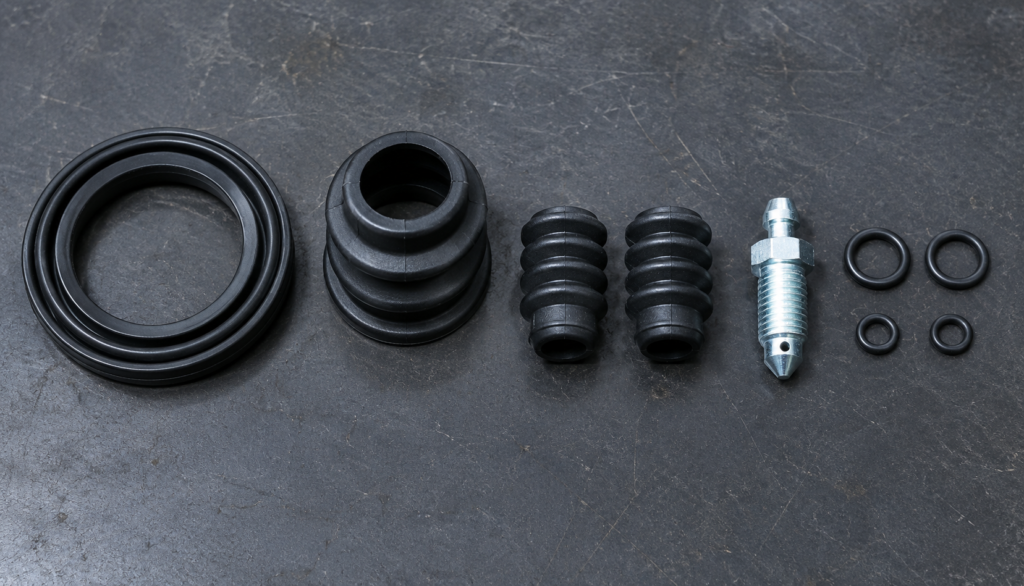
If you’ve been told your brake caliper needs attention and you’re staring at a wall of “rebuild kit” listings online, it’s easy to feel lost. Every kit looks slightly different, the part numbers rarely match what you’d expect, and it’s not always clear what you’re actually buying. This guide breaks down exactly what’s inside a brake caliper rebuild kit, how the parts work together, and how to figure out which kit actually fits your vehicle.
What Is a Brake Caliper Rebuild Kit?
A brake caliper rebuild kit is a package of small, wear-prone parts designed to restore an existing brake caliper to proper working condition, rather than replacing the entire caliper assembly. Instead of buying a whole new or remanufactured caliper, a rebuild kit lets you replace just the internal seals, boots, and hardware that wear out over time — while reusing the caliper housing and piston (or, in some kits, a new piston as well).
Rebuild kits exist because most caliper failures aren’t caused by the metal housing wearing out. The housing is built to outlast the vehicle in most cases. What actually fails is the rubber and hardware sealing it — and that’s precisely what a rebuild kit replaces.
What’s Inside a Typical Caliper Rebuild Kit
Contents vary by brand and vehicle application, but most brake caliper rebuild kits include a consistent core set of components:
- Piston seal (square cut seal): The primary internal seal that keeps brake fluid contained around the piston. This is the part most responsible for caliper function and is included in nearly every kit.
- Caliper dust boot: The rubber boot that keeps dirt, moisture, and road debris out of the piston bore. A torn dust boot is one of the most common reasons calipers get rebuilt in the first place.
- Slide pin boots: Smaller rubber boots that cover the slide pins on floating calipers, allowing the caliper to move freely as pads wear.
- Slide pins: Some kits include new slide pins, especially if corrosion or pitting is common on the vehicle application.
- Bleeder screw: A replacement bleeder valve, often included since old ones can seize or strip during a rebuild.
- O-rings and small seals: Additional o-rings for the bleeder screw and other small sealing points.
- Hardware clips and springs: Depending on the caliper design, some kits include the small retaining clips or anti-rattle hardware that holds pads in place.
Not every kit includes every item on this list, which is why reading the kit’s parts breakdown before buying matters more than judging by price alone.
What’s Usually Not Included
It’s just as important to know what a standard rebuild kit typically leaves out:
- The piston itself — most rebuild kits assume you’re reusing your existing piston, unless the piston is pitted, scored, or corroded, in which case a new piston kit or full caliper is a better option.
- Brake pads — rebuild kits address the caliper mechanism, not the friction material.
- Brake fluid — a caliper rebuild always requires a brake fluid flush, but the fluid itself is a separate purchase.
- Caliper mounting bracket hardware — some vehicles use a separate bracket with its own bushings, which may need a different kit entirely.
How Caliper Rebuild Kits Are Sized and Matched to Your Vehicle
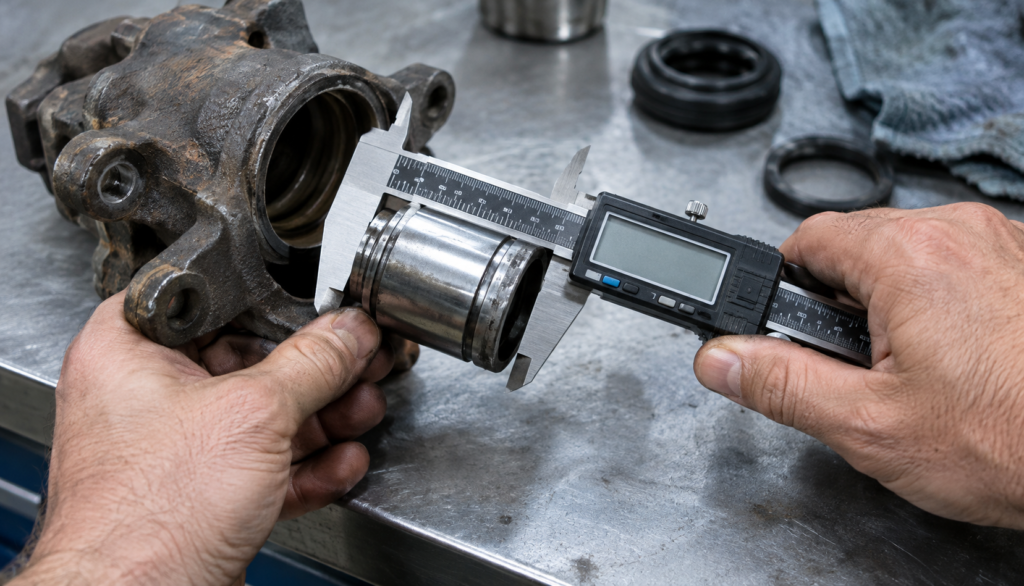
Caliper rebuild kits are not universal by default — they’re sized to match the specific piston diameter and caliper design used on your vehicle. Getting the wrong size kit is the single most common ordering mistake.
Kits are typically matched using one of the following:
- Piston diameter: Measured in millimeters, this is the single most important spec. Common sizes range from around 38mm to 60mm, though sport and heavy-duty applications can run larger.
- Year/make/model/trim: Most retailers let you search by vehicle, which cross-references the correct kit automatically. This is the simplest method if you’re not confident measuring piston diameter yourself.
- Caliper part number or casting number: Stamped or cast directly onto the caliper housing, this is the most precise way to confirm fitment, especially on vehicles with multiple caliper variants across trims.
- VIN-based lookup: Many parts retailers can pull exact caliper specs from your VIN, which is useful if your vehicle had a mid-year running change or trim-specific brake package.
If you’re ordering online without physically inspecting the caliper, VIN or part-number lookup is the safest method — vehicle dropdowns are usually accurate, but trim-level differences (like a sport package with larger brakes) can slip through.
Front vs. Rear Caliper Rebuild Kits
Front and rear caliper rebuild kits are almost never interchangeable, even on the same vehicle. Front calipers typically have larger piston diameters and handle more heat and force, since front brakes do the majority of stopping work. Rear calipers, especially on vehicles with an integrated parking brake mechanism, often have a more complex internal design — which means rear kits sometimes include additional parts, like specific seals for the parking brake actuator, that front kits don’t need at all.
Always confirm whether a listing is for front, rear, or both before ordering, since incorrect front/rear kits are a common return reason.
Single-Piston vs. Multi-Piston Caliper Kits
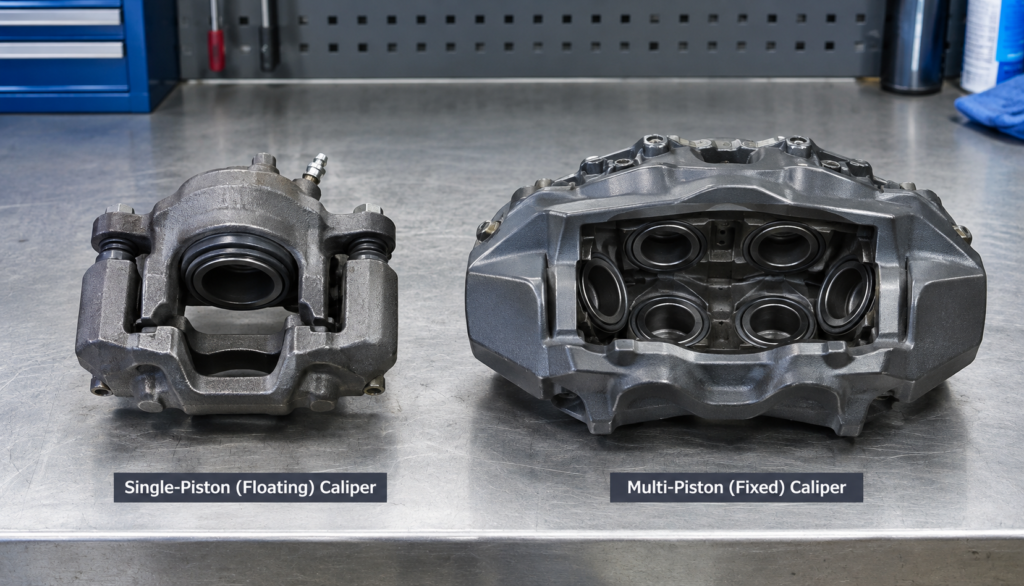
The number of pistons in your caliper directly changes what the rebuild kit looks like:
- Single-piston floating calipers are the most common design on daily-driven vehicles. Their rebuild kits are simpler, with one piston seal, one dust boot, and slide pin hardware.
- Multi-piston fixed calipers — common on performance trims and larger vehicles — have two, four, or even six pistons per caliper. Rebuild kits for these calipers include a matching number of piston seals and dust boots, and typically cost more due to the added parts count.
If you’re not sure how many pistons your caliper has, checking the caliper casting or a parts diagram for your specific vehicle is more reliable than guessing based on the vehicle’s general reputation for “performance brakes.”
Caliper Rebuild Kits for ABS-Equipped and Electronic Parking Brake Vehicles
Newer vehicles, especially those with electronic parking brakes (EPB), often use rear calipers with a built-in electric motor that drives the piston. Standard rebuild kits for these calipers typically only address the hydraulic seals and boots — they do not include the motor or actuator mechanism itself, since that’s a separate electronic component. If your rear calipers use EPB, confirm the kit is specifically listed as compatible with an electric parking brake caliper design, since standard mechanical rear kits will not fit correctly.
OEM vs. Aftermarket Caliper Rebuild Kits
Both OEM and aftermarket rebuild kits are widely available, and the right choice depends on priorities:
- OEM kits use the exact seal compound and dimensions specified by the vehicle manufacturer, which minimizes fitment guesswork but usually costs more.
- Aftermarket kits from established brake parts manufacturers are generally a good match in quality and are significantly more affordable, though quality can vary more between brands.
- Universal or generic kits sized only by piston diameter can work but carry the highest fitment risk, since they don’t account for vehicle-specific hardware differences beyond piston size.
For most daily-driven vehicles, a reputable aftermarket kit matched by vehicle or part number offers the best balance of cost and reliability. OEM kits make more sense on vehicles with known aftermarket fitment issues or unusual caliper designs.
Seal Material: Rubber vs. Silicone Compounds
Most caliper rebuild kits use an EPDM (rubber) seal compound, which is standard for the vast majority of vehicles and brake fluid types (DOT 3 and DOT 4). Some specialty and racing-oriented kits use silicone-based seals, which handle higher heat and are compatible with DOT 5 silicone brake fluid — but silicone seals are not compatible with standard DOT 3/4 fluid systems. Unless your vehicle specifically uses DOT 5 fluid, a standard EPDM rubber-sealed kit is the correct choice.
What the Warning Light Doesn’t Tell You
A brake warning light or a spongy pedal doesn’t tell you whether your caliper actually needs a rebuild kit, a full caliper replacement, or just fresh brake fluid. This is where a lot of DIY buyers get the purchase wrong.
Here’s what often gets missed: if the piston itself is pitted, corroded, or has visible scoring where the seal rides, a rebuild kit alone won’t fix the underlying problem — the new seal will simply wear against the same damaged surface and fail again, often within months. A rebuild kit is designed to restore a caliper with a sound piston and housing, not to compensate for physical damage to the piston surface. Before ordering a kit, it’s worth inspecting the piston (or having a shop inspect it) rather than assuming new seals alone will solve a leak or seizure.
It’s also easy to assume all rebuild kits for “your car” are the same kit — but if your vehicle offered a brake upgrade package, a heavy-duty trim, or towing package, the caliper piston size and hardware may differ from the base model, even though the car looks identical from the outside. Confirming fitment by part number or VIN, rather than by vehicle name alone, avoids this mismatch.
Frequently Asked Questions
Q. Do I need a different rebuild kit for front and rear calipers?
A. Yes, in almost all cases. Front and rear calipers typically use different piston sizes and, on many vehicles, different internal designs, so front and rear kits are not interchangeable.
Q. Can I use a universal caliper rebuild kit instead of a vehicle-specific one?
A. Universal kits sized by piston diameter can work, but they carry more fitment risk since they don’t account for vehicle-specific hardware like slide pins or parking brake components. A vehicle-specific or part-number-matched kit is generally safer.
Q. Does a caliper rebuild kit include a new piston?
A. Most standard rebuild kits do not include a new piston — they assume the existing piston is reused. If the piston is damaged, you’ll need a separate piston kit or a full caliper.
Q. How do I know how many pistons my caliper has?
A. Check your vehicle’s parts diagram or the caliper casting itself. Most daily-driven vehicles use single-piston floating calipers, while performance trims often use multi-piston fixed calipers.
Q. Are OEM caliper rebuild kits worth the extra cost over aftermarket?
A. OEM kits reduce fitment guesswork and use manufacturer-specified seal compounds, which can be worth it on vehicles with known aftermarket fitment issues. For most common vehicles, a reputable aftermarket kit matched by part number performs just as well at a lower cost.