
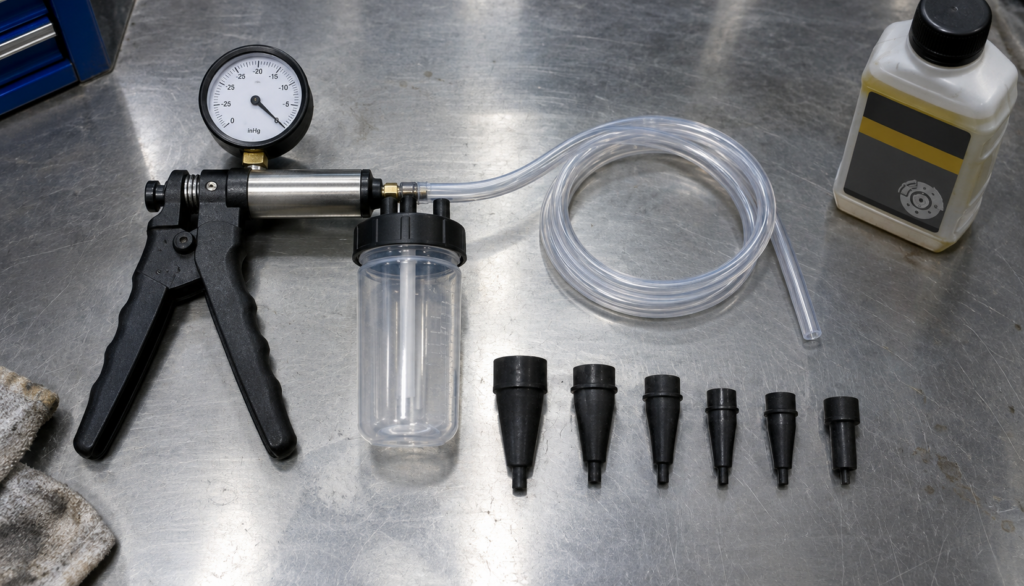
Mityvac is the name most home mechanics type into a search bar when a fresh fluid change is due, but the brand sells several very different tools under one label. One Mityvac brake bleeder is a hand pump you squeeze with your palm. Another runs off shop air and moves fluid at shop speed. A third pushes new fluid in through the master cylinder instead of pulling it out. If you pick the wrong one, you either overspend or end up with a tool that does not match the garage you actually have.
This guide sorts the main models, explains what each one does well, and shows where each one falls short. It will not walk you through every step of bleeding a car, because that is a separate job from choosing the tool. It will help you decide which kit is the best model for your situation, and whether a vacuum brake bleeder is worth it for the work you do.
Which Mityvac Brake Bleeder Models Are Worth Knowing?
Mityvac sells dozens of part numbers, but the brake-related lineup falls into four families. Knowing the family tells you almost everything about how the tool behaves.
- Hand pump kits: the MV8000 and MV8500, which use a hand vacuum pump and are built around one-person brake bleeding.
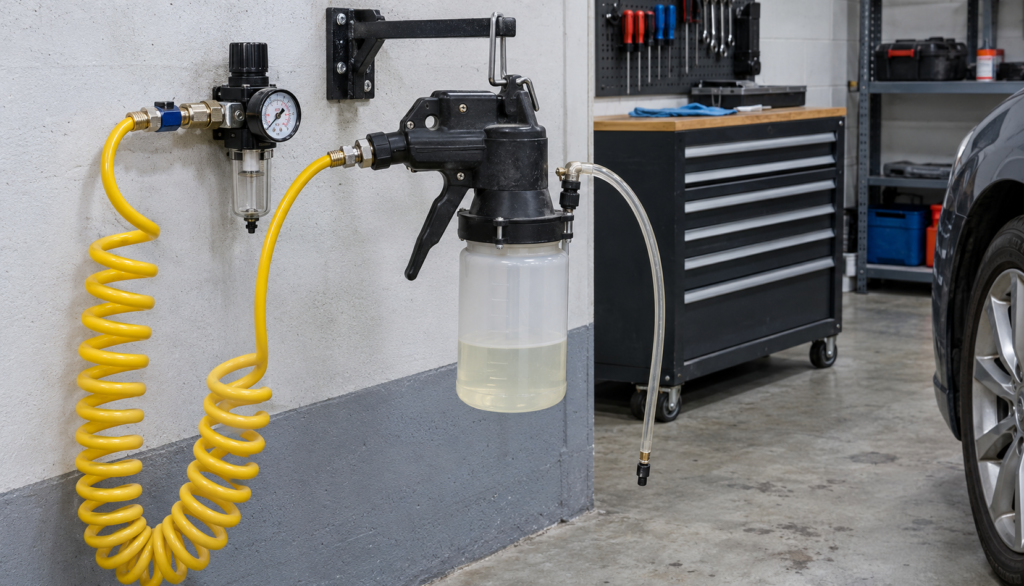
- Compressed-air vacuum bleeders: the MV6830 and MV6835, which need an air compressor and move fluid much faster.
- Pressure bleeders: the MV6840 system, which pushes fluid down from the master cylinder.
- Fluid evacuators with a bleeding kit: models such as the MV7201, which are mainly fluid-transfer tools that include a brake and clutch bleeding kit.
The deciding question is simple: do you own an air compressor? If you do not, the hand pump kits are the natural starting point. If you do, the compressed-air models open up faster, cleaner bleeding.
How a Mityvac Vacuum Brake Bleeder Works
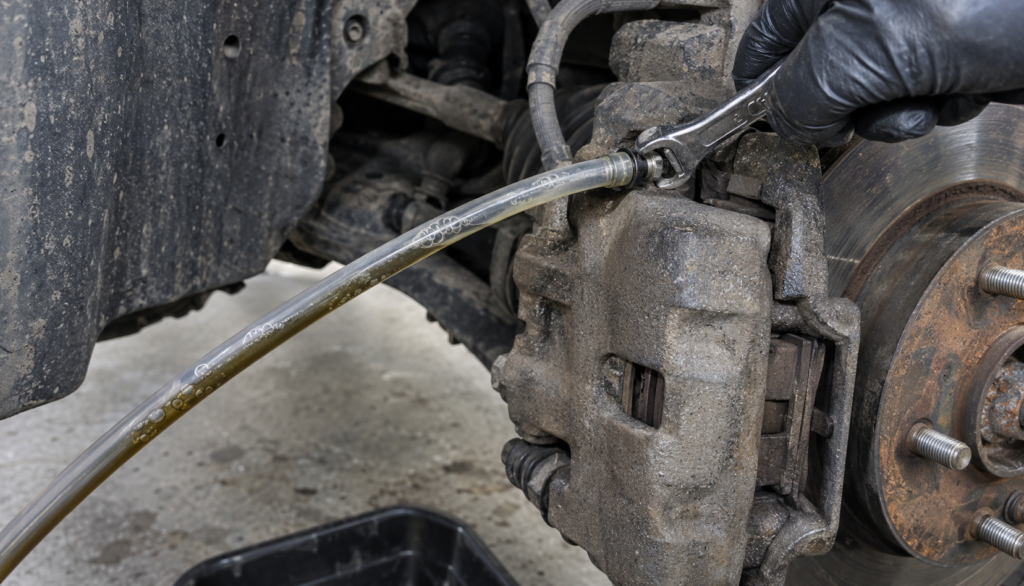
A vacuum brake bleeder works from the bleeder valve end of the brake system. You attach a hose to the bleed screw at the wheel, open the screw slightly, and the pump pulls old brake fluid and air bubbles out through the hose into a catch reservoir. Because you are not pumping the brake pedal, one person can do the whole job.
That is the main appeal. Traditional two-person bleeding needs a helper to press the pedal on command, and gravity bleeding takes a long time because you wait for fluid to creep out on its own. Vacuum bleeding sits in the middle: faster than gravity, and you can bleed brakes alone.
There is one habit you must keep. While the pump is pulling fluid out, the master cylinder reservoir has to stay topped up with fresh brake fluid. If the reservoir is allowed to run dry, the system pulls air into the brake lines, and you are back to square one. Some Mityvac kits include a refill kit that handles this automatically, which matters more than it sounds.
The other quirk is false bubbles. Vacuum can draw air past the threads of the bleed screw, so you see a steady stream of bubbles in the hose even when the brake lines are already clear. A wrap of thread tape on the screw threads, or a dab of brake-safe grease, usually stops it. If bubbles keep appearing no matter what you do, that points to a sealing problem at the screw, not air inside the hydraulic system.
Mityvac MV8000: The Hand Pump Starter Kit
The MV8000 is the original Mityvac hand vacuum pump kit. It centers on the Selectline hand pump with a vacuum gauge, and it includes a small fluid reservoir bottle, several tapered and universal bleed screw adapters, and a master cylinder refill kit. It is sold as an automotive tune-up and brake bleeding kit, which tells you how it is meant to be used: a general-purpose tool that also does brake work.
For a home garage, this is the lowest-commitment way into one-person bleeding. You squeeze the handle, watch the gauge, and fluid moves. The same hand pump also helps with vacuum testing and fluid transfer, so it earns its place in the toolbox even on weeks when no brake job is planned.
The trade-off is speed and effort. The catch bottle is small, so you will empty it more than once on a full flush. Each wheel also takes repeated pumping, which feels tiresome if you are changing fluid on several vehicles. It handles a clutch hydraulic line the same way, which is handy on manual-transmission cars.
Mityvac MV8500: Vacuum and Pressure in One Kit
The MV8500 Silverline Elite is a hand pump that delivers both vacuum and pressure, which is why it is often described as two pumps in one. For brake work, that dual ability means you can pull fluid out, and you can also use the pressure side for jobs that need fluid pushed in or dispensed.
It suits someone who wants a single hand pump to cover brake bleeding, power steering fluid, and general fluid transfer. Before you buy, read the listing carefully to see which adapters ship with it, because accessory contents differ between sellers and kit versions. Do not assume it contains every adapter your vehicle needs.
Like the MV8000, it is still a manual tool. It will not match a compressed-air unit for flow, but it costs far less than a pressure bleeder, and it avoids the need for any air supply.
Mityvac MV6830 and MV6835: Compressed-Air Models
The MV6830 is the model most mechanics picture when they say Mityvac vacuum brake bleeder. It runs on compressed air, and Mityvac rates it at up to two quarts per minute when supplied with 90 psi of shop air. Retailer listings show an operating pressure range of roughly 60 to 150 psi. The kit includes three universal bleed screw adapters, a bleed hose, a fluid evacuation hose, a hanging hook, and a base for bench mounting.
The MV6835 is the same tool with one important addition: the clamp-on auto-refill kit. That accessory keeps the master cylinder topped up while the bleeder runs, which removes the biggest risk of vacuum bleeding. Anyone planning regular brake flushes should lean toward this version, since a reservoir that runs dry can undo the whole job.
Two caveats apply. You need an air compressor that can keep up with the unit, and the bleeder is noisy compared with a hand pump. Compact garage compressors may cycle often. If you only service your own car once every couple of years, the MV6830 can be more tool than you need.
Mityvac MV6840: The Pressure Bleeder Option
The MV6840 works the other way around. It is a pressure bleeder: a fluid dispenser with a manual pump and a pressure gauge, plus a set of seven master cylinder adapters. The dispenser attaches to the master cylinder reservoir and forces new fluid down through the brake lines while old fluid and air leave through the bleed screws.
Pressure bleeding avoids the false-bubble problem altogether because nothing is pulling air past the screw threads. It also leaves you free to walk from wheel to wheel without worrying about the reservoir level, since the pressurized dispenser keeps it supplied.
The drawbacks are cost and fit. This is the most expensive of the group, and it only works well if the right master cylinder adapter seals properly on your vehicle. Some reservoirs have odd shapes or caps that are hard to match. Check that your model is covered before ordering.
Mityvac Brake Bleeder Models Compared
| Model | Power Source | Method | Best For | Main Limitation |
|---|---|---|---|---|
| MV8000 | Hand pump | Vacuum | Occasional DIY, one-person bleeding | Small bottle, slow on a full flush |
| MV8500 | Hand pump | Vacuum and pressure | One tool for several fluid jobs | Still manual; check included adapters |
| MV6830 | Shop air | Vacuum | Frequent bleeding with a compressor | Requires an air compressor |
| MV6835 | Shop air | Vacuum with auto-refill | Hands-off flushing | Same air demand as MV6830 |
| MV6840 | Manual pump | Pressure | Clean bleeds without false bubbles | Higher cost, adapter fit matters |
What the Warning Light Doesn’t Tell You
A soft pedal and a glowing ABS or brake light make many people reach for a bleeder first. A bleeder is a maintenance tool, not a diagnostic one, and it can hide a real problem if you use it as a first guess.
Air in the lines is only one cause of a spongy pedal. A leaking brake caliper seal, a weeping hose, a corroded brake line, or a failing master cylinder can all produce the same feel. If the fluid level keeps dropping after you bleed the brakes, you have a leak, and fresh fluid will simply drain out again. Bleeding a leaking system without finding the leak only delays the repair.
Another trap is the ABS unit. Air can sit inside the ABS module where an ordinary bleed never reaches it. If the pedal stays soft after a correct bleed, the next step often requires a scan tool that can cycle the ABS pump and valves. A Mityvac cannot do that part for you.
Old fluid also hides in plain sight. Both DOT 3 and DOT 4 brake fluid absorb moisture over time, and moisture lowers the boiling point. Fluid can look clean and still be unsafe under hard braking. Color is a poor guide, so follow the service interval in your owner’s manual. Many manufacturers call for a change roughly every two years, but the right interval depends on the vehicle, so confirm how often brake fluid should be changed in your own handbook.
Finally, a seized or rounded bleeder screw cannot be fixed with a better pump. Soaking the screw and using the correct wrench saves a trip to the machine shop, because a snapped bleed screw turns a quick fluid change into a major repair.
Brake Bleeding Basics Before You Start
Whichever tool you choose, a few rules apply. Check the service manual for the bleeding order, since many vehicles go from the wheel farthest from the master cylinder to the closest, but some brake layouts differ. Use only the fluid type printed on the reservoir cap, and never reuse fluid that came out of the system.
People often ask how long the job takes. Plan on a few hours for a first attempt, then less once you know the routine. Do not rush the pedal check at the end. Press the brake pedal firmly with the engine running, and confirm it feels firm before you move the car.
Used fluid is hazardous. Treat fluid disposal seriously by storing it in a sealed container and taking it to a recycling center or an auto parts store that accepts it. Brake fluid also strips paint, so wipe any spill off the brake caliper and surrounding bodywork right away.
Which Mityvac Model Should You Buy?
Match the tool to how often you will use it.
- Bleed once every year or two on one vehicle: the MV8000 is the practical, low-cost choice.
- Want one hand pump for brakes and other fluids: look at the MV8500.
- Own an air compressor and flush brakes often: choose the MV6835 over the MV6830 for the auto-refill feature.
- Want the cleanest results and have a matching master cylinder adapter: consider the MV6840 pressure bleeder.
Cheap bleeders from unknown brands can look tempting, but cheap bleeders often leak air at the hose connections, which wastes time and sends you chasing bubbles. A good seal at every adapter counts for a lot when the whole method depends on a clean vacuum. Competing pressure systems from brands such as Motive are worth comparing if you decide on the pressure route.
When to See a Mechanic
Bleeding is a reasonable home job, but some situations call for a shop. Go in if the pedal stays soft after a careful bleed, if the fluid level keeps falling, if the ABS light stays on, or if any bleed screw snaps or refuses to move. Also go in if you cannot tell whether the pedal feel is normal for your car. Brakes are a safety system, and a wrong guess costs far more than a shop visit.