
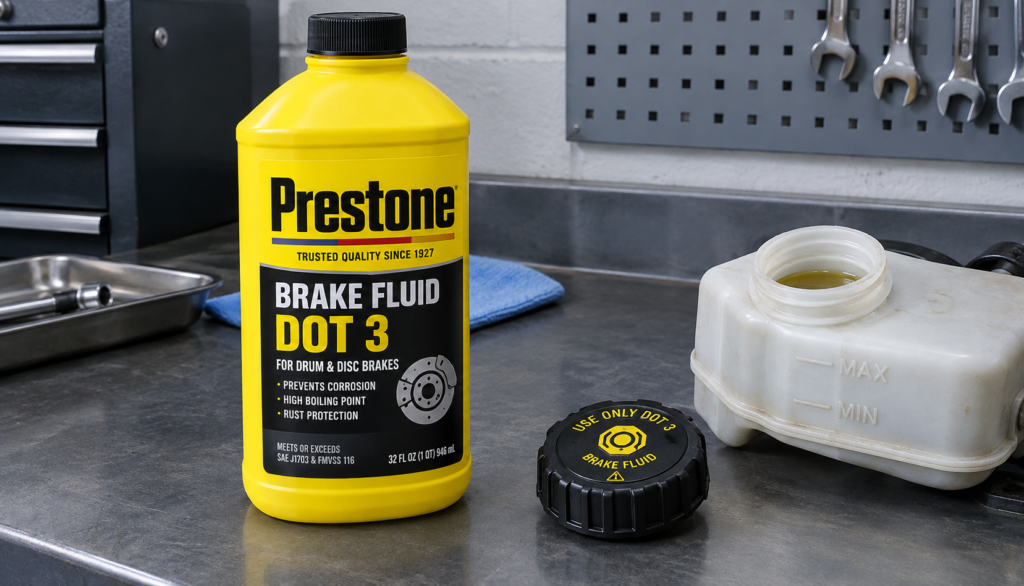
If you’re standing in the auto parts aisle holding a bottle of Prestone DOT 3 brake fluid and wondering whether it’s the right choice for your car, you’re not alone. Brake fluid is one of those maintenance items most drivers ignore until something goes wrong — and when they do pay attention, the DOT rating system creates more confusion than clarity. This guide breaks down what DOT 3 brake fluid actually does, how Prestone’s formula compares to alternatives, and whether your vehicle should be using it in the first place.
What Is DOT 3 Brake Fluid?
DOT 3 brake fluid is a glycol-based hydraulic fluid used in most standard passenger vehicles to transfer force from the brake pedal through the brake lines to the calipers and drums. The DOT rating comes from the U.S. Department of Transportation, which sets minimum performance standards for brake fluid viscosity, boiling point, and chemical compatibility.
The two most important DOT 3 specifications are its dry boiling point and wet boiling point. The dry boiling point refers to the temperature at which fresh, uncontaminated fluid begins to vaporize — for DOT 3, the minimum is 401°F (205°C). The wet boiling point applies to fluid that has absorbed water over time — for DOT 3, the minimum drops to 284°F (140°C). That gap between the two numbers is significant and explains why brake fluid maintenance matters even when your brakes feel fine.
Prestone DOT 3 is a glycol ether-based formulation that meets or exceeds these DOT minimum standards. It is designed for use in vehicles with conventional disc, drum, and ABS brake systems.
DOT 3 vs. DOT 4 vs. DOT 5: What’s the Difference?
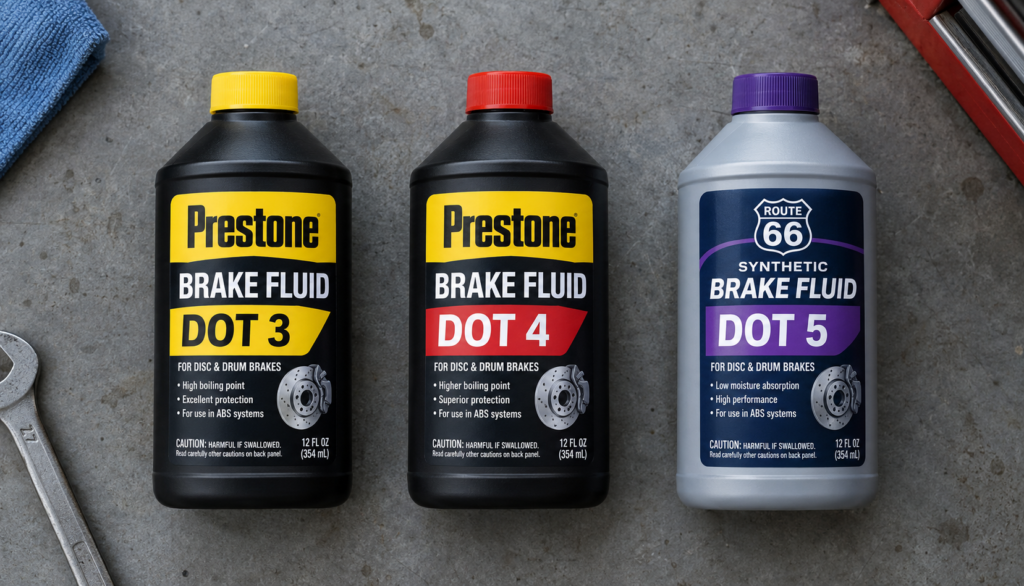
Understanding DOT 3 brake fluid means understanding where it sits in the DOT rating scale and why those differences matter for everyday driving.
| Fluid Type | Base | Dry Boiling Point | Wet Boiling Point | Typical Use |
|---|---|---|---|---|
| DOT 3 | Glycol ether | 401°F (205°C) | 284°F (140°C) | Standard passenger vehicles |
| DOT 4 | Glycol ether + borate ester | 446°F (230°C) | 311°F (155°C) | European cars, performance vehicles, ABS/ESP systems |
| DOT 5 | Silicone | 500°F (260°C) | 356°F (180°C) | Classic cars, military vehicles — not compatible with ABS |
| DOT 5.1 | Glycol ether | 518°F (270°C) | 375°F (190°C) | High-performance and racing applications |
The key distinction between DOT 3 vs. DOT 4 brake fluid is the higher boiling threshold in DOT 4. That matters in performance driving and in vehicles with aggressive braking demands, where the fluid in the calipers can approach temperatures that would vaporize DOT 3 and cause a sudden loss of pedal pressure — a phenomenon called brake fade.
DOT 5 silicone brake fluid stands in its own category. It does not absorb moisture, has a high boiling point, and is popular in classic car storage. However, DOT 5 is not compatible with ABS systems because it can compress slightly under heavy cycling, which disrupts ABS pressure modulation. If your vehicle has ABS, DOT 5 is off the table regardless of boiling point advantages.
DOT 5.1, despite sharing a name with DOT 5, is glycol-based like DOT 3 and DOT 4 — it is fully compatible with those fluids and is often used in racing contexts where the highest possible boiling point is required without giving up ABS compatibility.
Is Prestone DOT 3 Compatible with My Car?
The safest way to confirm DOT 3 brake fluid compatibility is to check your vehicle’s owner’s manual or the cap on your brake fluid reservoir. OEM brake fluid requirements are listed there and take priority over any general-use labeling on the bottle.
Most domestic vehicles — particularly older American cars and trucks, as well as many standard-use sedans and SUVs — are designed around DOT 3 specifications. Many Japanese-market vehicles also specify DOT 3, though some models have shifted to DOT 4 for newer trim levels with more advanced braking hardware.
European vehicles (BMW, Mercedes, Audi, Volkswagen, Volvo, and most others) almost universally specify DOT 4 or a manufacturer-specific equivalent. Putting DOT 3 in a vehicle designed for DOT 4 is technically permissible in an emergency — DOT 3 and DOT 4 are chemically compatible — but you are reducing the fluid’s boiling point safety margin and should flush and refill with the correct DOT 4 as soon as possible.
Never use DOT 3 or DOT 4 in a vehicle designed for DOT 5. The glycol and silicone bases are not compatible, and mixing them can cause swelling in rubber seals and brake system contamination.
Can You Mix DOT 3 with Other Brake Fluids?
Mixing different brake fluid brands is generally safe as long as the DOT rating is the same or higher. Prestone DOT 3 can be mixed with other DOT 3 formulations without issue. It can also be topped off into a system that contains DOT 4, though doing the reverse — adding DOT 3 to a DOT 4 system — dilutes the higher-spec fluid and lowers the overall boiling point of the mixture.
The brands themselves — Valvoline, Castrol, Motul, ATE — are all formulating to the same DOT 3 minimum standard, so brand-mixing is not a chemical concern. The concern is always the DOT number, not the label on the bottle.
What you should never mix is a glycol-based fluid (DOT 3, DOT 4, or DOT 5.1) with DOT 5 silicone brake fluid. That combination causes the fluids to separate, can damage rubber seals, and will degrade braking performance. If you are unsure what fluid is currently in your system, a full flush is the safest path before adding anything.
How Much Does Prestone DOT 3 Cost?
Prestone DOT 3 brake fluid is one of the more affordable options in the market. A standard 12 oz or 500ml bottle typically runs between $5 and $10 at retail — Walmart, AutoZone, O’Reilly Auto Parts, and Amazon all stock it regularly. Larger 32 oz bottles are available for around $10 to $15, which is cost-effective if you are doing a full brake fluid flush rather than a top-off.
Premium alternatives like Motul DOT 4 or ATE Super Blue command $15 to $25 per liter, but those are aimed at performance applications where the higher boiling point makes a tangible difference. For the average commuter car running DOT 3, the cheap brake fluid vs. expensive split mostly comes down to whether you need higher-spec than the base DOT 3 standard provides — which most everyday drivers do not.
A professional brake fluid flush at a shop typically runs $70 to $130 depending on labor rates and vehicle. DIY fluid flushes can be done with a fluid transfer pump or a one-person bleeder kit for under $20 in tools plus the cost of fluid.
How Often Should You Change DOT 3 Brake Fluid?
Most manufacturers recommend a brake fluid flush every 2 years or 24,000 miles, whichever comes first — though many drivers go far longer without issue and others flush more frequently. The reason for a time-based interval rather than purely mileage-based comes down to what DOT 3 brake fluid does between drives.
Glycol-based brake fluid actively absorbs moisture from the air through the brake lines and reservoir. This moisture absorption is gradual but constant. Even a vehicle sitting in a garage collects humidity in the brake system over time. As moisture content rises, the wet boiling point of the fluid drops. A fresh bottle of DOT 3 has a wet boiling point above 284°F. After two years of normal use and exposure, that number can fall significantly — enough to increase the risk of brake fade under heavy or extended braking.
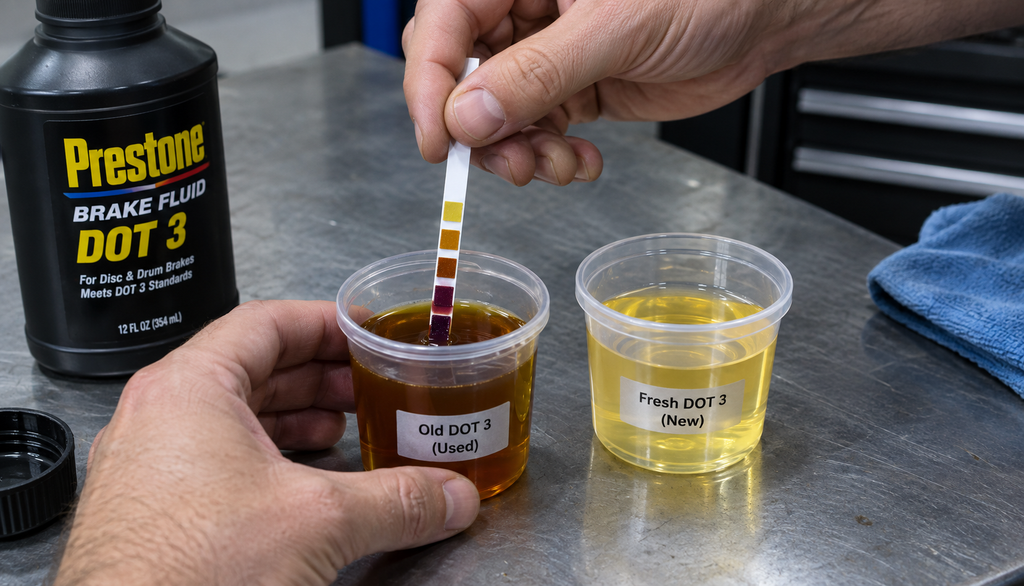
Brake fluid color provides a rough indicator. Fresh fluid is typically light yellow or nearly clear. Fluid that has darkened to amber or brown has degraded and absorbed contamination. Test strips designed for automotive brake fluid can measure moisture content more precisely and are available at most auto parts stores for under $10.
What the Warning Light Doesn’t Tell You
When a brake warning light comes on, most drivers’ first instinct is to check brake pad thickness or look for a leak. What the light cannot communicate is the condition of the fluid inside your brake lines — and degraded brake fluid can cause real braking problems without triggering any dashboard indicator at all.
Moisture absorption in DOT 3 brake fluid is invisible to every sensor in a standard passenger vehicle. Your car does not have a fluid-quality sensor; it has a fluid-level sensor. A system that is fully topped off with two-year-old fluid degraded by moisture saturation will show no warning light, even as its effective boiling point has dropped to a level where aggressive highway braking could produce vapor lock and a soft pedal.
The other thing the light misses is the difference between a fluid-level drop caused by normal brake pad wear (pads thin, pistons extend, fluid level drops slightly — expected) vs. a fluid-level drop caused by a leak (lines, calipers, master cylinder — not expected and not self-correcting). Topping off a leaking system with Prestone DOT 3 without finding the source of the leak delays the repair and masks a safety issue. If your fluid level drops more than a few millimeters between oil changes, inspect the brake lines and calipers before adding fluid.
Prestone DOT 3 vs. Other Budget Brake Fluid Brands
In the budget brake fluid category, Prestone competes with Valvoline Synpower, Castrol GT LMA, and store-brand options from major auto parts retailers. All of these meet the DOT 3 standard for dry boiling point, wet boiling point, and viscosity at low temperatures.
Castrol GT LMA (Low Moisture Activity) formulates for lower moisture absorption rates, which means the wet boiling point holds up slightly longer between flushes. Motul positions its DOT 3 and DOT 4 products toward European and performance applications and charges a premium accordingly. ATE brake fluid is popular with European car owners and often recommended by BMW and Mercedes technicians for its consistent formulation.
For a standard domestic or Japanese vehicle running within normal driving conditions, Prestone DOT 3 meets every real-world performance requirement. The premium alternatives add value primarily for vehicles with tighter brake system specifications, drivers covering high-stress driving patterns, or owners who extend flush intervals beyond the 2-year recommendation.
Frequently Asked Questions
Q. Can I use Prestone DOT 3 in a car that specifies DOT 4?
A. In an emergency top-off, yes — DOT 3 and DOT 4 are chemically compatible glycol-based fluids. But DOT 3 has a lower boiling point than DOT 4, so you are reducing your system’s safety margin. Flush and refill with the correct DOT 4 as soon as possible. Do not use DOT 3 as a long-term substitute in a DOT 4 system.
Q. How do I know if my brake fluid needs to be replaced?
A. The two clearest indicators are color (fresh fluid is pale yellow or clear; brown or dark amber means it’s time for a flush) and time (most vehicles should have brake fluid changed every 2 years regardless of mileage). Moisture test strips sold at auto parts stores give a more precise reading of water content.
Q. Is DOT 3 brake fluid safe for ABS systems?
A. Yes. DOT 3 is compatible with ABS systems. The only brake fluid that is not ABS-compatible is DOT 5 silicone brake fluid, which can compress under rapid pressure cycling and interfere with ABS modulation. Prestone DOT 3 is glycol-based and works correctly in vehicles with ABS, traction control, and electronic stability systems.
Q. What happens if you mix Prestone DOT 3 with DOT 5?
A. Mixing glycol-based DOT 3 with silicone-based DOT 5 is a serious problem. The two fluids are chemically incompatible, will not blend properly, and can damage rubber seals and brake components. If contamination has occurred, a full system flush with clean fluid is required before the vehicle is safe to drive.
Q. How long does an unopened bottle of DOT 3 brake fluid last?
A. An unopened, sealed bottle of DOT 3 brake fluid typically has a shelf life of 2 to 5 years when stored in a cool, dry location. Once opened, moisture begins entering the bottle immediately — use opened fluid within 12 months and reseal the cap tightly between uses. Do not store brake fluid in a partially-filled bottle for extended periods.