
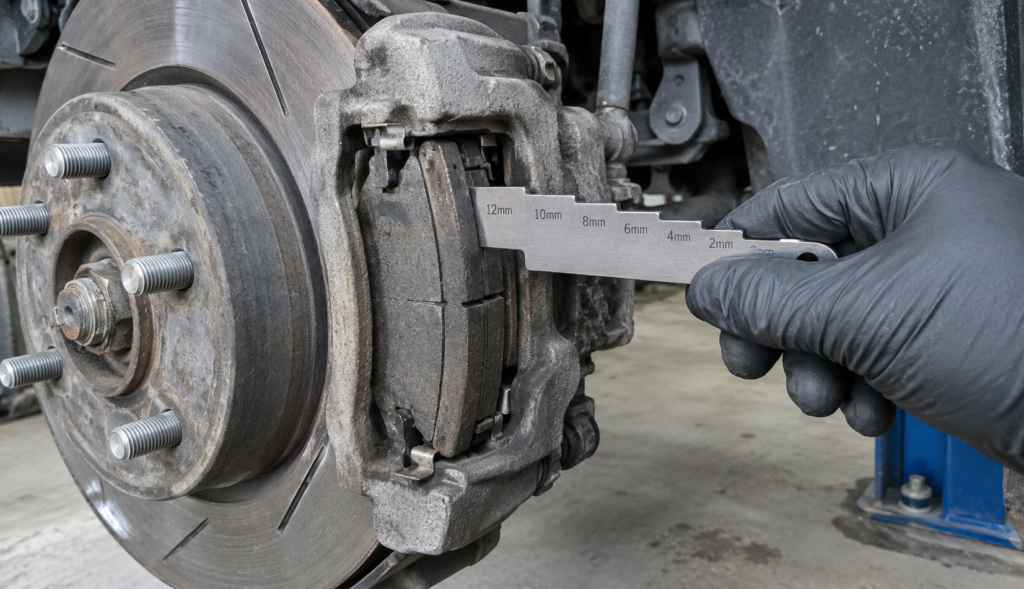
Brake pad thickness is the single most useful number to know about your brakes, because it tells you how much friction material is left before a routine job turns into an expensive one. New pads are usually between 10 and 12 millimeters thick, and most shops recommend brake pad replacement once the pad wears down to about 3 millimeters. That is roughly 1/8 inch, about the thickness of two stacked coins. This guide covers new brake pad thickness, minimum brake pad thickness, how to measure it yourself, and what to do when the number says it is time.
How Thick Are New Brake Pads?
The short answer to “how thick are new brake pads” depends on the vehicle, but most passenger cars land between 10 and 14 millimeters of friction material. That figure covers only the friction material, the part that actually clamps the brake rotor. It does not include the steel backing plate the material is bonded to. A complete pad, backing plate included, measures closer to 15 to 20 millimeters, which is why measuring the wrong layer is the most common mistake people make.
Compact cars tend to use the lower end of that range, while trucks and SUVs often ship with thicker pads because they carry more weight. Brake pad thickness in mm is the standard way to talk about this, because spec sheets, pad boxes, and the service manual all use metric. If you only think in inches, 12 mm is just under 1/2 inch.
Brake Pad Thickness Chart: New, Worn, and Replace Now
Use this brake pad thickness chart as a general guide. Your own vehicle’s specification always takes priority over a generic table.
| Remaining Thickness | Approx. Inches | What It Means | What to Do |
|---|---|---|---|
| 10 to 12 mm | 3/8 to 1/2 in | New or nearly new | Nothing needed |
| 7 to 9 mm | 1/4 to 3/8 in | Normal, healthy wear | Recheck at your next service |
| 5 to 6 mm | 3/16 to 1/4 in | Getting low | Start planning a replacement |
| 3 to 4 mm | 1/8 to 5/32 in | Replace soon | Book the job this week |
| 2 mm or less | Under 1/8 in | Worn brake pads past the safe limit | Stop driving it and replace the pads |
Minimum Brake Pad Thickness: How Thin Can Brake Pads Get?
The minimum brake pad thickness most manufacturers and shops work to is 3 millimeters. Some vehicle makers list 2 millimeters as the absolute limit, but that leaves almost no margin. Many mechanics replace pads at 3 to 4 mm because pads wear faster as they thin out and have less material to absorb heat. So when people ask “how thin can brake pads get,” the safe answer is not “as thin as the manual allows.” It is thin enough that you still have a comfortable buffer before your next check.
Another common question is “what is the legal minimum brake pad thickness?” There is no single number that applies everywhere. Some regions and inspection programs set their own limits, and the rules are different for commercial vehicles. Check your local inspection requirements rather than trusting a number from a forum post.
A very common search is “is 3mm brake pad safe,” and the honest answer is that it will still stop the car, but only just. Stopping distance grows as pads thin out and overheat, so 3 mm is a number that means you should act soon, not a number that means you can keep going for another year. If you are at that point, it is time to stop asking whether and start planning when to replace brake pads.
How to Check Brake Pad Thickness
The most reliable way to check brake pad thickness is with the wheel off. Park on level ground, loosen the lug nuts, lift the car onto jack stands, and remove the wheel. Look at the caliper from the side. The pad sits between the caliper and the brake rotor. Measure the friction material only, using a brake pad thickness gauge or a vernier caliper. A simple brake pad gauge has stepped notches marked for roughly 3, 5, 8, and 10 mm, so you can read the result in a few seconds.
Always check both the inner pad and the outer pad. The inner pad, which sits against the caliper piston, usually wears faster. Take your reading at the thinnest point, since pads can wear in a wedge shape. Repeat the process at every wheel, because front brake pads and rear brake pads wear at very different rates.
The easiest habit to build is a tire rotation brake inspection. The wheels are already off, so measuring takes an extra thirty seconds per corner. That also answers “how often to inspect brakes”: every time you rotate your tires, or at least twice a year.
How to Measure Brake Pad Thickness Without Removing the Wheel
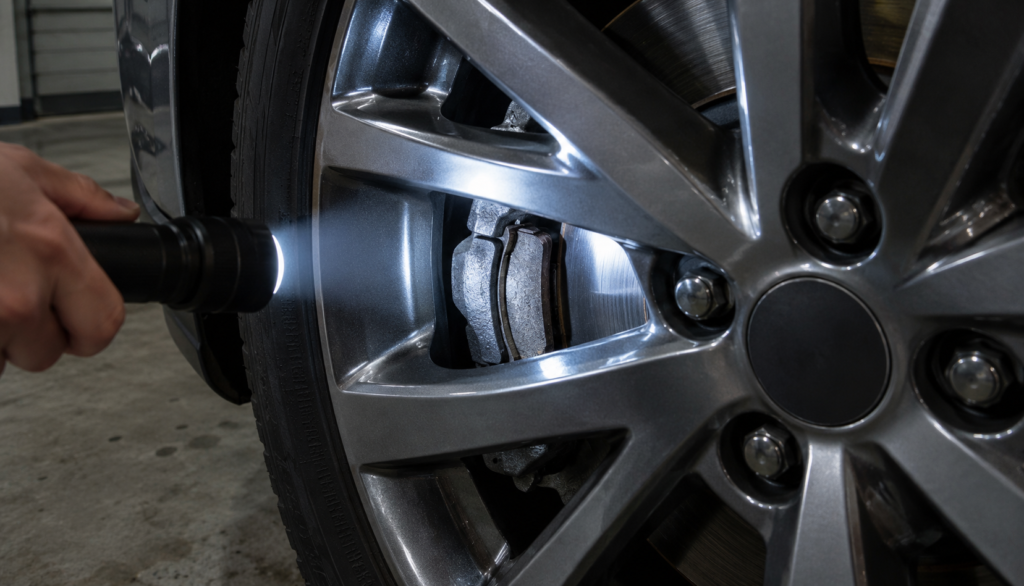
Many cars with open-spoke alloy wheels let you see the outer pad without taking anything apart. Shine a flashlight through the spokes and look at the edge of the pad where it meets the rotor. Compare the friction material with the steel backing plate. If the friction material looks thinner than the backing plate, you are probably at 6 mm or less. A phone camera pushed close to the spokes can also show you the inner pad that your eyes cannot reach.
The limitation is obvious: you are only seeing one pad, and the one you cannot see may be thinner. Treat a quick look as a screening step, not a final measurement. If the flashlight check shows less than about 5 mm, pull the wheel and measure properly.
Brake Pad Thickness for Front vs Rear Brakes
Front brake pads do most of the stopping, often 60 to 70 percent of it, because weight shifts forward under braking. That is why front pads are usually thicker when new and still wear out first. Rear brake pads are commonly 8 to 10 mm when new, and on many cars they last two to three times longer than the fronts.
Never assume the rear brakes match the front. Check each axle on its own, and replace pads in axle sets rather than one wheel at a time. Replacing a single side leaves you with uneven braking force, and the car can pull toward the stronger side under hard braking.
Does Brake Pad Material Change Thickness?
Ceramic brake pads, semi-metallic brake pads, and organic brake pads all start at similar thicknesses, so the replacement threshold stays close to 3 mm no matter which you have. The brake pad material differences show up in how they wear and what they do to the rest of the system.
Semi-metallic pads handle heat well and last a long time, but they wear rotors faster. Ceramic pads are quieter, produce less brake dust, and tend to wear evenly. Organic pads are the softest and wear fastest. People also ask, “do thicker brake pads last longer?” Within the same material the answer is yes, since there is more friction material to wear through. But a thicker aftermarket pad that does not fit the caliper properly can drag against the rotor, so always match the original specification.
Why Brake Pads Wear Unevenly
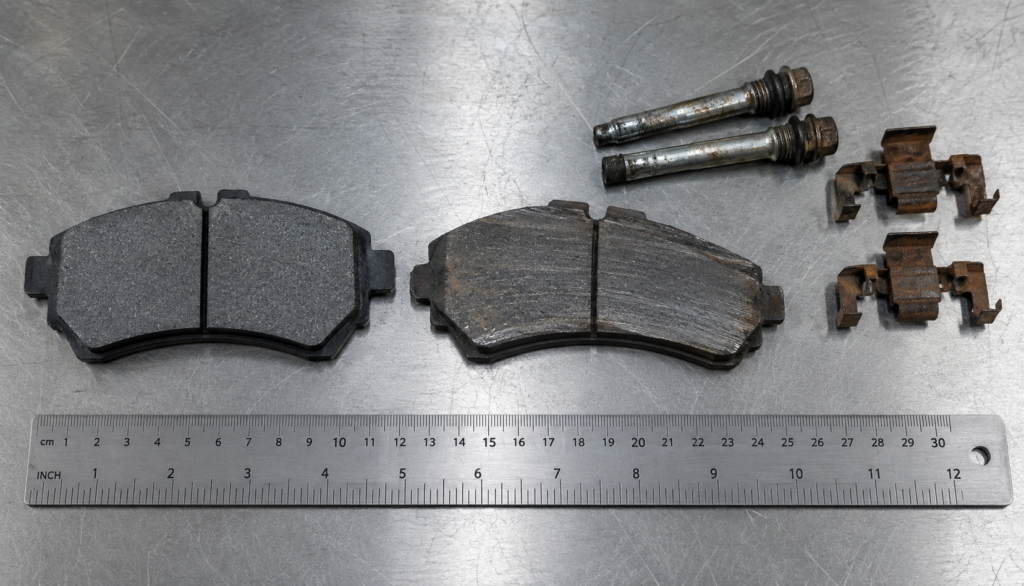
Uneven brake pad wear causes usually come down to the hardware, not the pads themselves. The usual suspects are sticking caliper slide pins, a partly seized caliper piston, and rusty pad clips. If the inner pad is much thinner than the outer pad on the same wheel, the slide pins are probably not moving freely. If one wheel is far more worn than the other on the same axle, suspect the caliper on the worn side.
Pad taper wear, where one end of the pad is thinner than the other, is another sign of binding hardware. Left alone, it shortens pad life and can cause a pulsating pedal later on. Driving matters too. Brake pad lifespan and driving habits are closely tied: city stop-and-go traffic, towing, and hard braking wear pads out far sooner than steady highway miles. So when drivers ask “how long do brake pads last,” the honest range is wide, roughly 30,000 to 70,000 miles depending on the car and how it is driven.
What the Warning Light Doesn’t Tell You
Some cars use an electronic wear sensor in the pad that lights up the brake warning light when the friction material runs low. Do not count on it. Not every car has one, and on cars that do, the wear sensor usually triggers at around 2 to 3 mm, which is already past the comfortable replacement point. It is also typically fitted to only one pad per axle, so the other pads can be thinner than the one being monitored. And a lit brake warning light does not always point at the pads at all. Low brake fluid or a partly engaged parking brake can turn it on just as easily.
The mechanical brake pad wear indicator, a small metal tab that touches the rotor, works the same way and starts to make a squealing noise at roughly the same thickness. Treat that noise as your early warning. A grinding noise is far worse. Metal on metal means the friction material is gone and the backing plate is cutting into the rotor.
That is where a cheap fix becomes a big one. Rotor damage from worn pads often means new rotors, and sometimes a damaged caliper as well. Every rotor also has a rotor minimum thickness stamped on its edge, usually marked as “MIN TH.” Fitting new pads on a rotor that is already below that number is false economy.
Finally, good pad thickness does not mean the brakes are healthy. A spongy brake pedal usually points to air in the brake lines or a brake fluid problem, and a pulsating pedal usually points to a warped or unevenly worn rotor. Neither one is a pad thickness problem, and no gauge reading will explain them. Many drivers also ask, “can you drive with worn brake pads?” A short, careful trip to a shop at 3 mm is usually fine. Once you hear grinding, it is not.
When to See a Mechanic
Measuring is easy, but some results call for a professional. Book an appointment with a mechanic if any of these apply:
- Your pads measure 3 mm or less at any wheel.
- You hear a grinding noise, or a squealing noise that does not go away after the first few stops.
- The car pulls to one side when you brake.
- One pad is much thinner than the others on the same axle.
- The brake pedal feels soft, or the brake fluid level keeps dropping.
- You cannot get a clear reading, or you are not comfortable working under a jacked-up car.
A shop can measure the rotor, check the slide pins, and flag a bad caliper in the same visit, which saves you from repeating the job a few months later. If you have more than a year since your last full brake inspection, ask for one even if the pads look fine.
FAQ
Q. What is the minimum brake pad thickness?
A. Most mechanics replace pads at 3 mm (about 1/8 inch), and 2 mm is the point where pads are past the safe limit. Check your service manual for the exact number for your vehicle.
Q. How thick are new brake pads?
A. New pads typically have 10 to 12 mm of friction material, though some vehicles run up to 14 mm. Rear pads are often a little thinner than the fronts.
Q. Can I drive with 2 mm brake pads?
A. You should not. At 2 mm the pads are past the safe limit, stopping distance increases, and you risk grinding into the rotor. Replace them as soon as possible.