
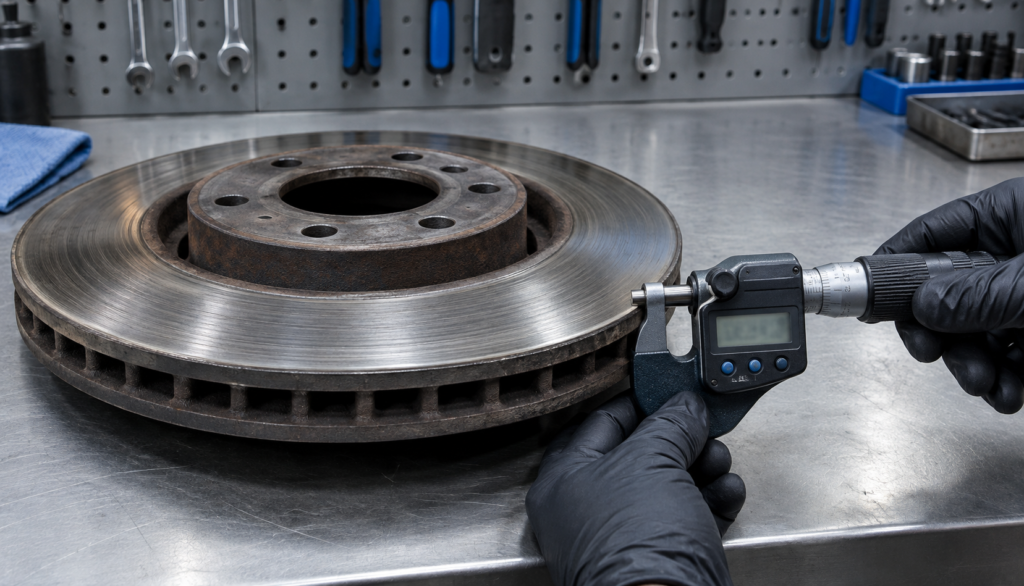
Most brake rotors last somewhere between 30,000 and 70,000 miles, though plenty of them go well past that and a few wear out sooner. The wide range surprises people, because the rotor is a solid piece of metal that never looks like it is doing much. In reality, every stop turns your forward motion into heat and friction at the rotor surface, and that work slowly removes material from it.
This guide explains the real brake rotor lifespan you can expect, what makes it shorter or longer, how to tell when a rotor is finished, and what to do about it. If you already feel a shudder when you brake, the section on warning signs is the one to read first.
How Long Do Brake Rotors Last on Average?
For a typical passenger car driven normally, a set of rotors lasts about 50,000 to 70,000 miles. Smaller cars with light rotors and aggressive stopping can be done closer to 30,000 miles. Heavy trucks used for towing often see the same low number, since they ask far more of the brakes on every stop.
Those figures are averages, not promises. Two owners with the same car can get a 40,000-mile difference purely from how and where they drive. The only reliable answer for your own vehicle comes from measuring the rotor thickness during a brake inspection, not from the odometer.
| Driving Situation | Typical Rotor Life (Miles) |
|---|---|
| Gentle highway driving, light vehicle | 60,000 to 80,000+ |
| Mixed daily commuting | 40,000 to 70,000 |
| Heavy city driving, constant stop-and-go | 30,000 to 50,000 |
| Frequent towing or hauling heavy loads | 25,000 to 45,000 |
| Hybrid or electric vehicle with strong regenerative braking | 70,000 to 100,000+ |
What Determines Brake Rotor Lifespan?
Several factors decide how quickly the rotor surface wears down, and they stack on top of each other.
Driving habits. Late, hard braking generates far more heat than gradual slowing. Your driving habits are usually the single biggest variable, which is why one driver replaces rotors twice before another replaces them once.
Where you drive. Constant city driving means dozens of stops per trip. Long highway driving means very few. Hilly roads add another layer, because holding speed downhill keeps the brakes working for long stretches.
Vehicle weight and towing. A heavier vehicle carries more momentum, so the rotors absorb more energy every time. Adding a trailer multiplies that.
Rotor quality and material. Most rotors are cast iron, but the alloy, thickness, and manufacturing quality differ a lot. When comparing OEM vs aftermarket rotors, the cheapest options often use thinner castings that shed material and dissipate heat poorly. Coated rotors resist surface rust and look better on the shelf, but the coating only protects the non-contact areas.
Pad type. The pad is what rubs against the rotor, so its compound matters. Semi-metallic brake pads grip well under heat but are harder on rotors. Ceramic brake pads are quieter, produce less brake dust, and tend to be gentler on the rotor surface. Organic brake pads are soft and quiet but wear out faster. Pairing the wrong pad with your driving style can cut rotor life noticeably.
Climate and road salt. In regions where roads are salted in winter, corrosion attacks the rotor faster than normal use does. A rotor can look fine on the working surface while the hat section and edges are badly eaten by rust.
Front Rotors vs. Rear Rotors: Which Wear Out First?
The front rotors almost always wear out first. During braking, weight shifts forward, so the front axle handles roughly 60 to 70 percent of the stopping force. That is why front rotors are usually bigger and why they are replaced more often.
The rear rotors can last twice as long, sometimes the life of the car on gentle vehicles. The exception is a rear brake that seizes. A sticking brake caliper or a stuck parking brake can chew through a rear rotor in a fraction of the normal distance, so an unusually worn rear rotor is a clue to look at the hardware, not just the rotor.
Do Brake Rotors Need to Be Replaced With Every Brake Pad Change?
Not automatically. Older advice said rotors should last through two sets of brake pads, and that was often true when rotors were thick and heavy. Modern rotors are lighter and thinner to save weight and cost, so many only survive one pad cycle and some do not make it that far.
What matters is the measurement. Every rotor has a minimum thickness stamped on the hat or edge, often labeled as the discard thickness. A micrometer reading tells the mechanic whether there is enough metal left to be safe with new pads. If the rotor is above minimum and the surface is smooth, it can stay. If it is near or below the number, it has to go regardless of mileage.
Also worth knowing: putting fresh pads on a rotor with deep grooves or an uneven surface leads to poor contact, noise, and fast pad wear. Many shops recommend replacing both together for that reason.
Signs Your Brake Rotors Are Wearing Out
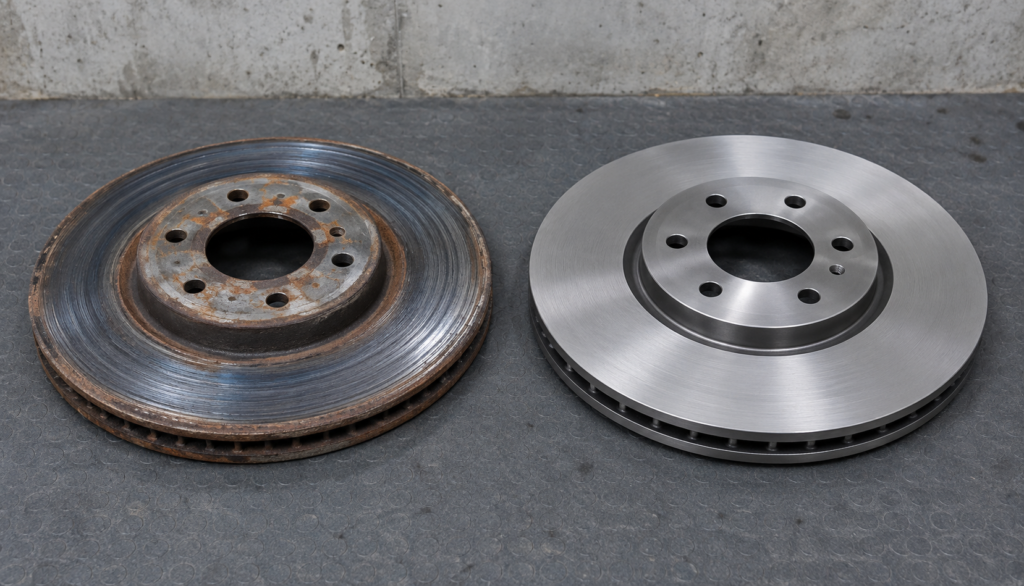
If you are wondering about the signs of bad brake rotors, these are the ones that show up most often:
- Pulsation in the pedal. A rhythmic pushback through the brake pedal while slowing usually points to uneven rotor thickness or brake rotor runout (the rotor wobbling slightly as it spins on the wheel hub).
- Shaking in the steering wheel. A vibration you feel in the steering wheel at highway speeds when braking suggests the front rotors have an issue.
- Squealing. A high-pitched squealing sound can come from pad wear indicators, glazed pads, or a rotor surface that has hardened.
- Grinding noise. A harsh grinding noise usually means the pad material is gone and metal is meeting metal. Stop driving the car as soon as it is safe to do so.
- Visible grooves and scoring. Deep lines in the rotor face mean debris or worn pads have been cutting into it.
- A lip on the rotor edge. The outer edge where the pad does not reach builds a raised ridge as the swept area wears down.
- Blue discoloration or hot spots. Dark blue patches or spotty dark areas are signs of overheating that can harden the metal and cause uneven wear.
- Longer stopping distance. If the car takes more road to stop than it used to, the brakes are not delivering what they should.
Plenty of people call every shudder “warped rotors,” but true warping from heat alone is less common than uneven pad material transferring onto the surface. The result feels the same, and the fix is usually the same, but the cause matters for preventing a repeat.
What the Warning Light Doesn’t Tell You
Here is the part most drivers miss: there is no dashboard light for rotor wear. The red brake light usually tells you about low fluid or a parking brake that is still applied. The ABS light tells you about a sensor or module fault. Neither one measures how much rotor wear has happened. A rotor can sit below its minimum thickness with a perfectly dark dashboard.
Some cars do have a pad wear sensor that triggers a message, but that monitors the pad material only. It says nothing about the rotor underneath it. By the time the pads trigger a warning, the rotors may already have a lip, grooves, or heat damage.
There are two other traps worth knowing:
- A cheap fix can hide a bigger cause. If one set of rotors wears out in half the normal distance, the rotor was not the problem. Look for a sticking caliper, seized caliper slide pins, or a dragging parking brake that keeps the pad pressed on the surface all the time.
- Old brake fluid makes everything worse. Moisture-laden fluid lowers its boiling point and can cause weak, spongy braking and hard-working components. It is one more reason to follow the maintenance schedule for fluid, even though it never touches the rotor directly.
Because the car will not warn you, the visual check and thickness measurement are the only real protection. Ask for them whenever the wheels come off, such as during a tire rotation.
Can You Resurface Brake Rotors Instead of Replacing Them?
Yes, if there is enough metal left. Resurfacing means a lathe shaves a thin layer off both faces so the surface is flat and smooth again. It only works when the finished thickness will still be above the minimum, and when the rotor has no deep cracks, heavy hot spots, or serious rust damage.
In practice, many shops no longer offer it. New rotors for common cars cost so little that the labor to machine the old ones is close to the price of a replacement, and thinner modern rotors often do not have material to spare. If a shop does resurface, ask for the final thickness in writing so you know how much margin is left.
How Much Does Rotor Replacement Cost?
The cost of rotor replacement depends on the vehicle, the parts you choose, and the shop. As a rough guide, a pair of rotors alone for a common sedan can run from about $30 to $150 per rotor in parts, with labor on top. A full job with new pads on one axle usually lands around $300 to $700 at a repair shop, and higher for trucks, performance cars, or luxury brands.
| Job | Typical Cost Per Axle |
|---|---|
| Rotors only (parts and labor) | $200 to $450 |
| Rotors and pads together | $300 to $700 |
| Performance or drilled and slotted rotors | $500 to $1,000+ |
| Resurfacing existing rotors (where offered) | $40 to $100 per rotor |
These are estimates, and prices vary by region and shop. Drilled and slotted rotors look sporty and shed gas and water, but for everyday driving they rarely last longer than a plain rotor, so they are not a mileage upgrade.
How to Make Brake Rotors Last Longer
You cannot stop rotors from wearing, but you can slow it down.
- Brake earlier and more gently. Look ahead and ease off the throttle so you scrub speed gradually instead of slamming the pedal late.
- Choose pads that suit your driving. Ceramic pads are a good everyday choice for commuting. Heavy loads may need a semi-metallic compound.
- Bed in new brakes properly. Bedding in new brakes means a series of moderate stops from moderate speed, with cooling time, following the pad maker’s instructions. It lays down an even transfer layer and helps prevent pulsation later.
- Service the hardware. Clean and lubricate caliper slide pins at each pad change so the pad releases fully.
- Replace pads on time. Worn-out pads damage the rotor quickly, and the metal backing plate will cut grooves into it.
- Don’t ride the brakes downhill. Shift to a lower gear so the engine helps hold speed.
- Rinse off salt and keep the car moving. A car that sits for weeks grows surface rust, and winter road salt speeds corrosion on every exposed metal part.
- Avoid parking with hot brakes. Parking right after a hard stop with the brakes still hot can leave pad imprints on the rotor.
When to See a Mechanic
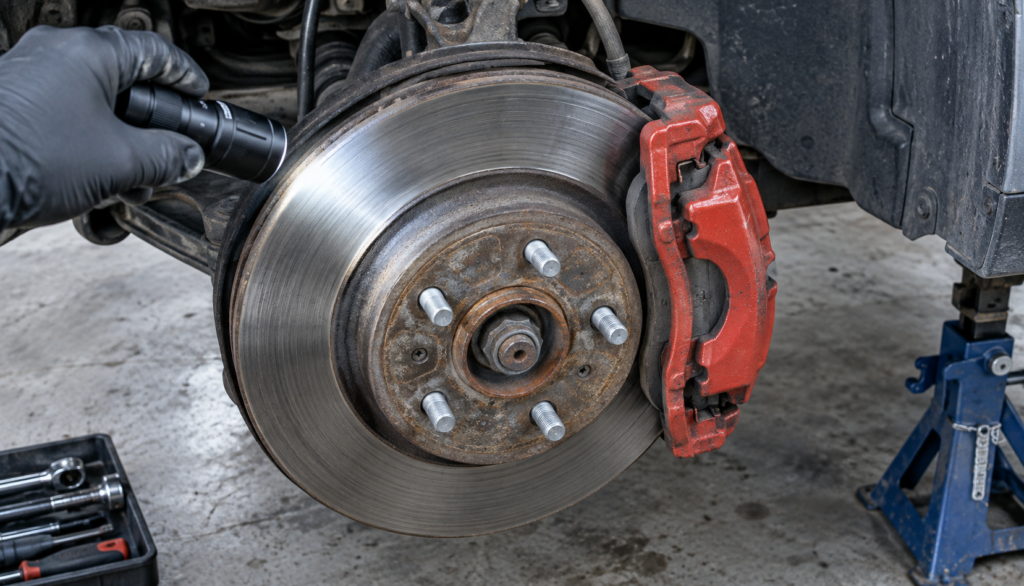
Do not wait for a failure. Book a brake inspection if you notice pulsation in the pedal, shaking in the wheel, a metallic grinding noise, a car that pulls to one side when braking, or a longer stopping distance. Any of those can mean a rotor is past its limit or that a caliper is stuck.
Even with no symptoms, have the rotors measured once a year or at every pad replacement. A thickness reading takes a minute and tells you whether you have another 20,000 miles or a few weeks. If the pedal goes soft or the car will not slow normally, stop driving and have it towed.
FAQ
Q. How many miles do brake rotors last?
A. Most rotors last 50,000 to 70,000 miles under normal driving. Towing, heavy city traffic, and aggressive braking can cut that to 30,000 miles, while gentle highway use and hybrid or electric vehicles with regenerative braking can stretch it past 80,000.
Q. How often should brake rotors be replaced?
A. There is no fixed interval. Rotors should be replaced when they reach the minimum thickness stamped on them, or sooner if they have deep grooves, cracks, heat damage, or cause a steady pulsation that will not clear. A yearly measurement tells you far more than mileage alone.
Q. Can you replace just the pads and keep the same rotors?
A. Sometimes. If the rotors are still above minimum thickness and the surface is smooth and even, fresh pads can go on them. If the rotors are grooved, lipped, or near the limit, replacing both gives better braking and avoids paying for another pad job soon.
Q. Do drilled and slotted rotors last longer than standard ones?
A. Not for everyday driving. They can help shed heat, water, and gas under hard use, but they often wear pads faster and can develop cracks around the holes. A quality plain rotor is usually the better choice for normal commuting.
Q. Is it safe to drive on worn brake rotors?
A. It depends on how worn they are. A little uneven wear may only cause vibration, but rotors below minimum thickness can overheat, crack, and reduce stopping power. If you hear grinding or the pedal feels wrong, get the car checked before driving it further.