
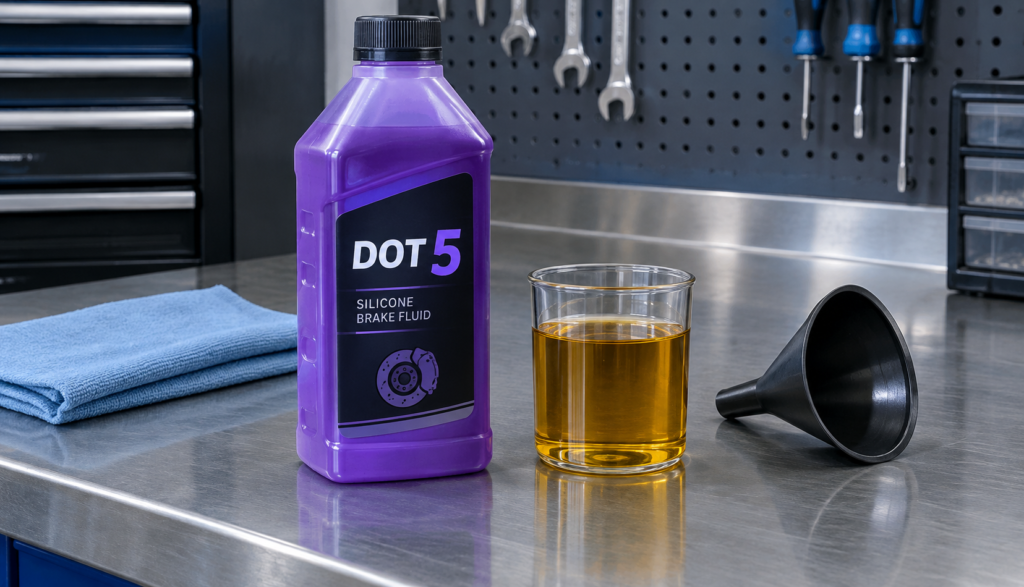
DOT 5 brake fluid is the odd one out in the brake fluid family. DOT 3, DOT 4, and DOT 5.1 are all glycol-based, but DOT 5 is silicone-based, and that single difference changes almost everything about where it works, where it fails, and what it can be mixed with. If you have a bottle in your hand, or an owner’s manual that mentions it, this guide explains what you are dealing with before anything goes into the fluid reservoir.
The short version: DOT 5 is a niche product. It suits certain classic cars, stored vehicles, and some motorcycles, and it is the wrong choice for most modern cars, especially anything with ABS. Pouring the wrong fluid into the brake system rarely causes a dramatic failure on day one. Instead, it usually shows up weeks later as a spongy brake pedal at the worst possible moment.
What DOT 5 Brake Fluid Actually Is
Brake fluid is the hydraulic fluid that carries pressure from your foot to the brake calipers and wheel cylinders. Every brake fluid sold in the United States has to meet FMVSS 116, the federal standard that sets minimum boiling points and maximum viscosity limits. “DOT” stands for Department of Transportation, and the number tells you the grade.
DOT 5 uses a silicone base instead of glycol ether. That makes it non-hygroscopic, which means it does not absorb moisture from the air the way other brake fluids do. It also has a very high boiling point, and it does not damage paint the way glycol fluids can.
So what color is DOT 5 brake fluid? Purple, by long-standing convention. Manufacturers dye it that way so nobody mistakes it for the clear or amber DOT 3 and DOT 4 sitting on the next shelf. The color is a safety feature, and it is one of the easiest ways to tell what is already in an older car’s master cylinder.
DOT 5 Brake Fluid Specs at a Glance
The table below compares DOT 5 with the other common grades using the minimum figures set by the federal standard. The dry boiling point is the temperature for fresh fluid straight from a sealed bottle, and the wet boiling point is the temperature after the fluid has absorbed some water in service.
| Property | DOT 3 | DOT 4 | DOT 5 | DOT 5.1 |
|---|---|---|---|---|
| Base | Glycol ether | Glycol ether / borate ester | Silicone | Glycol ether / borate ester |
| Dry boiling point (min) | 401°F (205°C) | 446°F (230°C) | 500°F (260°C) | 500°F (260°C) |
| Wet boiling point (min) | 284°F (140°C) | 311°F (155°C) | 356°F (180°C) | 356°F (180°C) |
| Viscosity at -40°C (max) | 1,500 mm²/s | 1,800 mm²/s | 900 mm²/s | 900 mm²/s |
| Hygroscopic | Yes | Yes | No | Yes |
| Typical color | Clear to amber | Clear to amber | Purple | Clear to amber |
| Mixes with glycol fluids | Yes | Yes | No | Yes |
DOT 5 is also the most expensive of the group. Expect to pay noticeably more per quart than DOT 3 or DOT 4, and prices vary by brand and retailer, so check current listings before you budget. If you are only trying to figure out what a fluid service costs at a shop, that is a separate question with its own answer.
DOT 5 vs DOT 5.1: Do Not Confuse the Two
DOT 5 vs DOT 5.1 is the most common mix-up in the brake fluid aisle, and the similar names are the reason. On paper, the boiling points are identical. In practice, the two are completely different products.
DOT 5.1 is glycol-based. It is hygroscopic, it is compatible with DOT 3 and DOT 4, and it works fine in ABS systems. DOT 5 is silicone-based, it is not compatible with any of them, and it does not belong in most ABS systems. If a car calls for a higher-performance fluid than DOT 4 and you want to upgrade, DOT 5.1 is almost always the right answer, not DOT 5.
Can You Mix DOT 5 With DOT 4?
Can you mix DOT 5 with DOT 4? No. Silicone and glycol do not blend. Instead of forming a uniform fluid, they separate into pockets and droplets that circulate through the hydraulic system. That leaves you with inconsistent pedal feel, and it can contaminate the rubber seals in the master cylinder and calipers.
The same rule applies to DOT 3. Any glycol-based fluid, including DOT 3, DOT 4, and DOT 5.1, is incompatible with silicone. If you are not sure what is in a system, do not top it off. Have it flushed and refilled with one fluid type from end to end.
Which Vehicles Use DOT 5 Brake Fluid?
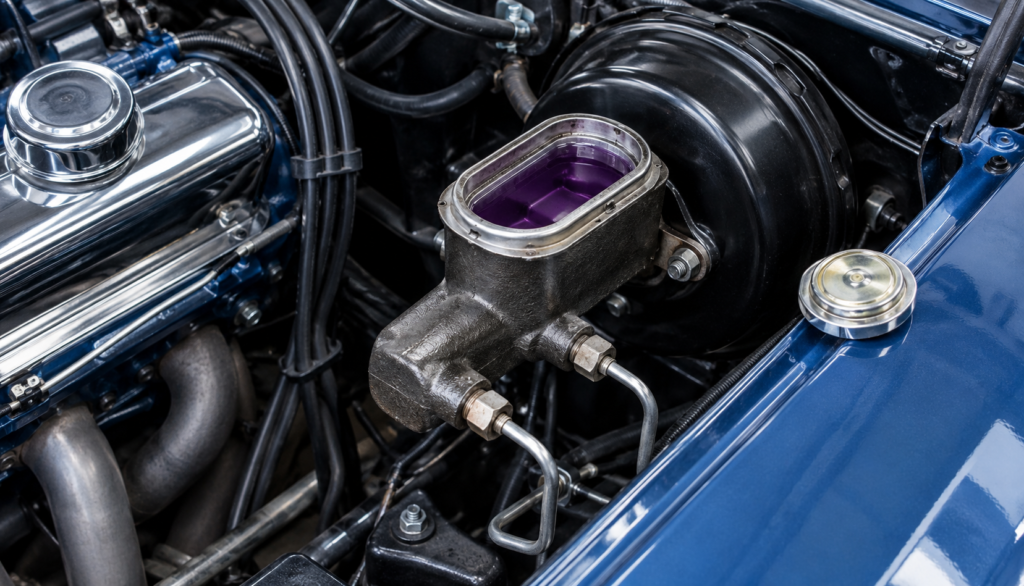
The question of what cars use DOT 5 has a short and specific answer. DOT 5 was originally developed for military vehicles that sit unused for long periods, because a fluid that does not absorb moisture will not corrode the brake lines from the inside while the vehicle waits. That same logic explains why it still appears in these situations:
- Classic cars and show cars: Owners like that DOT 5 will not strip paint if a drop escapes during a rebuild.
- Long-term storage vehicles: Seasonal cars, trailers, and project builds that sit for months benefit from a fluid that does not pull in moisture.
- Some motorcycles: Older Harley-Davidson models, for example, shipped with DOT 5, though many newer bikes specify DOT 4. Always confirm before topping off a motorcycle.
- Military and specialty vehicles: Where the manufacturer specifies it for the brake system.
Most modern daily drivers are not on this list. If your owner’s manual or the reservoir cap says DOT 3, DOT 4, or DOT 5.1, that is what the system was engineered around. The cap and the manual are the two sources you should trust over any forum advice.
Why DOT 5 Does Not Belong in ABS Systems
Can DOT 5 be used in ABS? In most cases, no, and this is the most important limitation on the spec sheet. Silicone fluid has a tendency to hold tiny air bubbles in suspension instead of releasing them. That effect is called aeration, and it is a problem because air compresses while fluid does not.
An ABS pump cycles fluid extremely quickly when it activates, which whips air into the fluid. Any air bubbles that form in DOT 5 tend to stay there, and the result is a soft, inconsistent brake pedal exactly when the ABS is working hardest. Vehicle manufacturers design their ABS hydraulic units around glycol fluids for this reason, and using DOT 5 can also void warranty coverage on the components.
If you drive a car built in the last few decades, assume ABS is present unless you know otherwise, and assume DOT 5 is off the table.
DOT 5 Brake Fluid Pros and Cons
| Advantage | Drawback |
|---|---|
| Does not absorb water, so it does not degrade the way glycol fluid does | Any water that does get in cannot be absorbed and pools at low points |
| High dry and wet boiling points | Holds air bubbles, which can cause a spongy pedal |
| Safe on paint and finished surfaces | Not compatible with DOT 3, DOT 4, or DOT 5.1 |
| Lower viscosity in cold weather | Poor fit for most ABS systems |
| Long service life in stored vehicles | Higher price per quart |
So is DOT 5 brake fluid better than DOT 4? It is better at resisting moisture and at protecting paint. It is worse at handling the demands of a modern braking system. Better is only meaningful when the fluid matches what the system was built for.
What the Warning Light Doesn’t Tell You
Neither the brake warning light nor the ABS light can tell you that the wrong fluid is in the system. Both lights respond to low fluid level, pressure loss, or a sensor fault, and a reservoir full of the wrong fluid can look perfectly healthy. The problems tend to show up in the brake pedal first.
Here is what the dashboard will not warn you about:
- A soft pedal after a fluid change is not always air from a poor job. If DOT 5 is in the system, bleeding it again may not fix the spongy feeling, because silicone holds air so stubbornly. Repeated bleeding on a system that will not firm up is a sign to question the fluid, not the technique.
- Non-hygroscopic does not mean water-proof. Because DOT 5 does not absorb moisture, any water that enters through a worn seal or a loose cap settles as separate droplets at the lowest points, often inside a caliper. A small pool of water there can boil under heavy braking or cause corrosion long before the fluid itself looks bad.
- Common moisture testers can mislead you. Many test strips and testers are calibrated for glycol fluids, so readings on a silicone fluid can be meaningless. Judge the fluid by service history and inspection instead.
- Mixed fluid looks fine at first. Contamination between silicone and glycol can leave the reservoir looking normal while the rubber seals slowly degrade, so the symptoms often appear weeks or months later.
- The paint claim can be a trap. DOT 5 is easier on paint, but that is a reason to choose it for a show car, not a reason to install it in a daily driver with ABS.
The takeaway: a cheap fix, like topping off with the correct fluid, can turn into an expensive one if the wrong fluid has been in the hydraulic system for a while. A soft pedal is always worth a proper diagnosis.
What Switching Fluid Types Really Involves
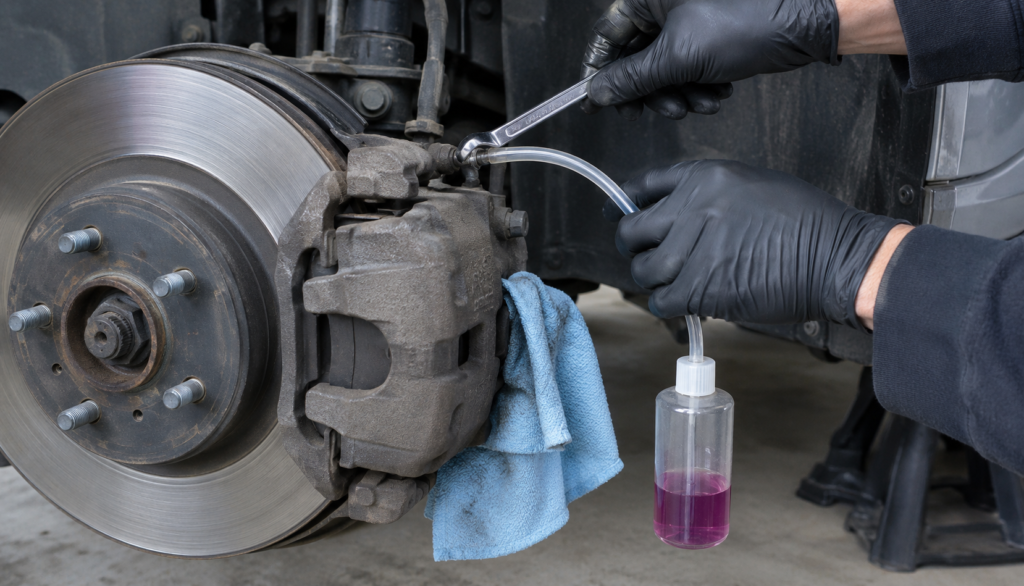
People often ask how to switch from DOT 4 to DOT 5, usually because they want a set-and-forget fluid for a classic. It is not a simple swap. Every trace of the old glycol fluid has to leave the system, which means a complete flush of the brake lines, calipers, and master cylinder, not just a bleed at each wheel.
Even then, residual glycol can remain in the rubber seals and flexible hoses, and those parts are often replaced during a conversion. Many shops will not attempt it on a daily driver for that reason. If you are building or restoring a vehicle and plan to use DOT 5, the cleanest approach is to do it during a full rebuild with new seals, so the system starts silicone-only.
Going the other direction, from DOT 5 back to a glycol fluid, requires the same thorough flush. The step-by-step procedure for a fluid change is its own topic, and it should be done by someone who has the tools to do it properly.
When to See a Mechanic
Book a brake inspection soon if you notice any of these signs:
- A brake pedal that feels soft, spongy, or sinks slowly toward the floor
- You are unsure which fluid type is currently in your system
- Purple fluid in a car that is not a classic or specified DOT 5 vehicle
- Fluid in the reservoir that looks milky, dark, or cloudy
- An ABS light that appears after any fluid service
If the pedal is sinking or the brakes feel unreliable, do not keep driving to see how it goes. Brakes are a safety system, and a professional inspection is cheap compared with the cost of a failure. If you have already mixed fluids, tell the shop up front so they can plan a full flush rather than a top-off.
Frequently Asked Questions
Q. Is DOT 5 brake fluid better than DOT 4?
A. Not for most cars. DOT 5 resists moisture and protects paint, but it holds air and does not suit ABS systems. DOT 4 is designed for modern braking systems and is the safer choice unless your manual says otherwise.
Q. Does DOT 5 brake fluid absorb water?
A. No. It is non-hygroscopic, so it does not absorb moisture. That prevents the gradual boiling point drop seen in glycol fluids, but any water that enters will pool at low points in the system instead of dispersing.
Q. Is DOT 5 brake fluid safe on paint?
A. Yes. Unlike glycol-based fluids, which can damage paint, silicone fluid does not strip or soften a finish. That is one reason restorers use it, but it does not make DOT 5 suitable for every vehicle.
Q. What happens if you use the wrong brake fluid?
A. It depends on the mismatch. Mixing silicone with glycol fluid can cause a spongy pedal and seal damage, while an incorrect grade may lower the boiling point. The fix is a complete flush and refill with the correct fluid, and often an inspection of the seals.
Q. How often should you change DOT 5 brake fluid?
A. Follow the vehicle manufacturer’s interval. Because it does not absorb water, DOT 5 tends to hold up longer in storage, but it still needs periodic replacement and a system inspection, particularly on vehicles that sit for long stretches.