
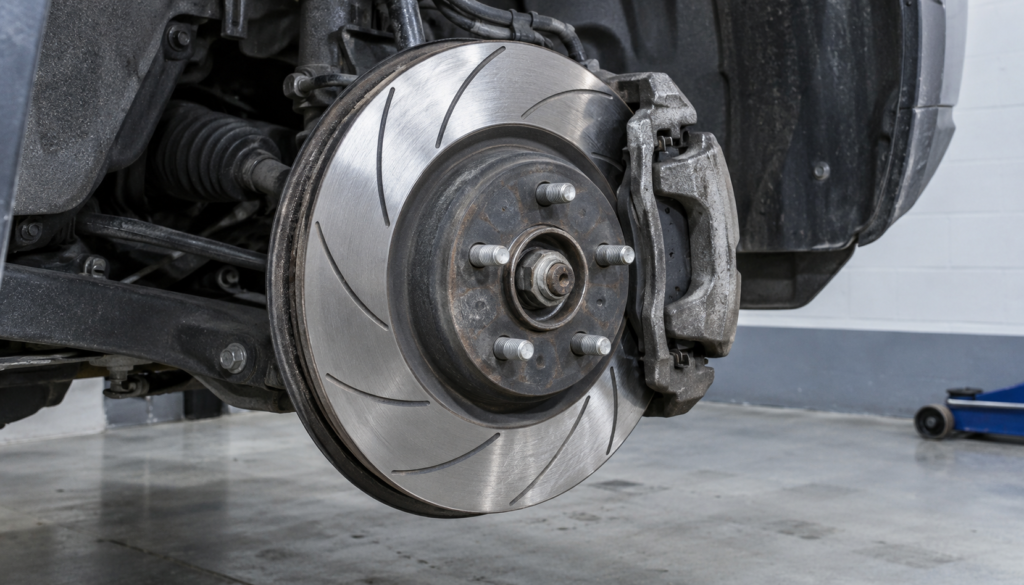
Slotted brake rotors are disc brake rotors with shallow channels machined across the rotor surface, and they appear in almost every aftermarket catalog. If you are shopping for new brake rotors, the marketing makes them sound like a free upgrade for any vehicle. They are not a free upgrade, and they are not a waste of money either. They are a specific tool built for specific driving, and this guide covers the specs, the trade-offs, and who actually benefits from them.
What Are Slotted Brake Rotors?
A slotted rotor is a normal cast iron disc with slots cut into each rotor face. The slots are usually shallow, often only a millimeter or two deep, and they run in a straight or curved pattern from the center of the rotor toward the outer edge. Everything else in the braking system stays the same: the brake caliper squeezes the brake pads against the rotor surface, and friction slows the vehicle.
Most slotted brake rotors are sold in the same rotor diameter as the factory part, so fitment on a given vehicle is normally identical to OEM rotors. The difference is the surface pattern, not the size or the mounting. That is why they are a popular aftermarket swap during a routine replacement.
How Slotted Brake Rotors Work
Under hard braking, the pad material heats up and releases a thin layer of gas and fine dust between the pad and the rotor. That layer reduces pad bite and can contribute to brake fade. The slots give that gas, along with water and debris, somewhere to escape. This is the main idea behind gas and debris evacuation, and it is the best-supported benefit of the design.
The slots also sweep across the pad face on every rotation. That constant wiping keeps the pad surface fresh and helps prevent glazing, which is the hard, shiny layer that makes brakes feel weak. In wet weather braking, the slots help clear water off the rotor surface so the pads can grip sooner.
What slots do not do is dramatically improve heat dissipation. Most of the cooling comes from vented rotors, where internal directional vanes pull air through the rotor. Slots add a small amount of edge area, but the gain is modest. Anyone promising a big jump in stopping power from slots alone is overselling them.
Slotted vs Drilled Rotors
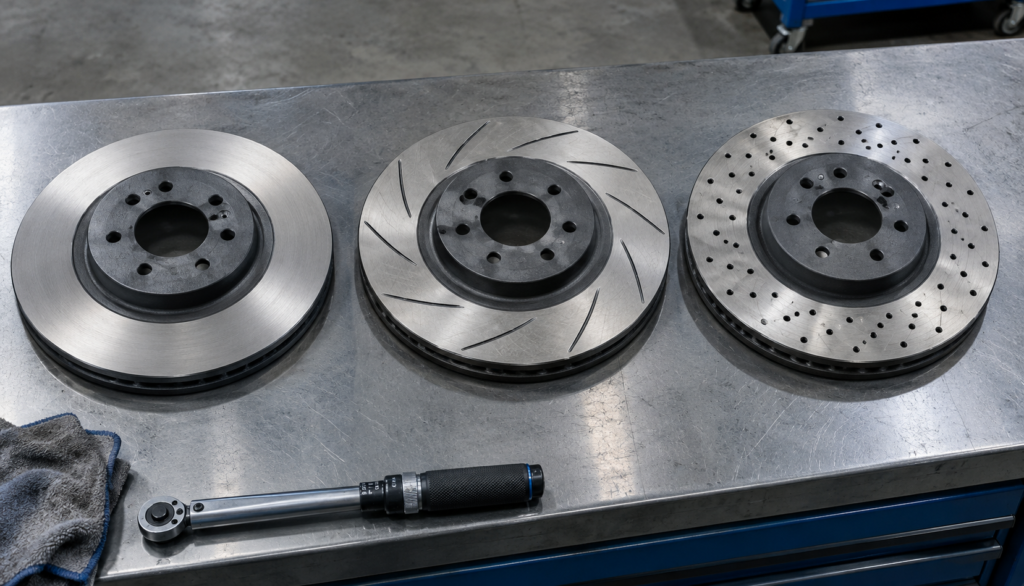
The choice between slotted vs drilled rotors comes up in every buying guide. Cross-drilled rotors have holes through the rotor face instead of channels. The holes release gas and water well, but they also create stress points, and rotor cracking around the holes is a known issue under repeated heavy heat cycles. Slotted designs avoid that weak point, which is why they are more common on vehicles that tow or see sustained hard use.
| Rotor Type | Best For | Cracking Risk | Pad Wear | Typical Noise |
|---|---|---|---|---|
| Blank rotors (smooth) | Daily commuting, quiet operation | Low | Lowest | Quietest |
| Slotted | Spirited street use, towing, wet climates | Low to moderate | Slightly higher | Mild whirring possible |
| Cross-drilled | Light-duty street appearance, occasional hard use | Higher | Moderate | Mild to moderate |
Blank rotors are the standard factory choice for a reason. For a normal commuter car they deliver the quietest, longest-lasting result. Slotted rotors only make sense when your driving gives the slots something to do.
Slotted Brake Rotor Specs to Check Before Buying
Two slotted rotors can look identical and perform very differently. Quality varies a lot, so check these specs before you pay.
- Rotor diameter and fitment: Match the exact rotor diameter and hat height for your vehicle. A near-fit is not a fit.
- Rotor thickness: New thickness should match the original. Every rotor has a minimum thickness specification, usually stamped on the edge, and a thin cheap rotor reaches it quickly.
- Vented or solid: If the original was vented, the replacement must be vented. Many sets use directional vanes, which makes them left and right specific, so check the side before you install.
- Slot depth and pattern: Shallow, cleanly machined slots are better than deep ones, which can weaken the rotor face.
- Material and coating: Good rotors use consistent cast iron. A zinc or similar rotor coating keeps the hat and edges from rusting on the shelf and in service.
- Rotor runout: Look for a stated runout tolerance. Excess runout is a leading cause of pedal pulsation after a brake job.
On price, slotted brake rotors usually cost noticeably more than blank rotors of the same quality tier, and the spread between budget and premium sets is wide. A very low price on a slotted set is usually a sign of thin castings and sloppy machining, not a bargain.
Are Slotted Rotors Worth It for Daily Driving?
For most people, choosing slotted rotors for daily driving is a preference, not a need. A commuter car in normal traffic rarely generates enough heat for slots to matter, and the slight increase in pad wear and noise is a real cost for a small benefit. If your priority is quiet, long-lasting brakes, blank rotors are the better match.
Slotted brake rotors earn their price in a few situations:
- Towing and heavy loads: Repeated hard stops with a trailer build heat, and the slots help keep the pad surface clean.
- Track day use: Sustained braking is where gas buildup and glazing show up first.
- Performance driving on the street: Spirited mountain or canyon driving works the brakes harder than a commute.
- Wet or dusty climates: Water and debris clearing can improve consistency.
Slotted Rotors, Brake Pad Compatibility, and Pad Wear
Rotors and pads work as a pair, so brake pad compatibility matters. The pad material you choose changes how the combination behaves. Semi-metallic pads handle heat well and bite hard, which suits a slotted rotor in demanding use, but they wear the rotor surface faster and create more brake dust. Ceramic pads run quieter and cleaner, and they pair well with slotted rotors for street use, though they can fade sooner under extreme heat.
So do slotted rotors wear pads faster? Yes, a little. The slots continually shave the pad face, so expect pads to wear somewhat quicker than on blank rotors. How much depends on the pad material and your driving. Many drivers see a modest difference, and it is one reason a slotted setup costs more over its lifespan.
Do Slotted Rotors Make Noise?
Many drivers ask about slotted rotors noise before buying, and the concern is fair. Some sets produce a faint whirring or ticking sound at light braking, especially with aggressive pad material, as each slot passes under the pad. Quality rotors and ceramic pads reduce it. A loud grinding or scraping noise is a different problem and means something else is wrong, such as worn pads or a stuck caliper.
Pedal feel can change slightly too. Many drivers report a firmer, more consistent pedal on slotted rotors in hard use, but the difference is subtle in ordinary driving.
What the Warning Light Doesn’t Tell You
Your dashboard has no rotor warning light. The brake warning light only reports things like a low fluid level or an applied parking brake, so worn, thin, or uneven rotors give you no electronic notice. You find out by feel and sound, which is why the non-obvious facts below matter.
- Slots do not cure warped rotors. Pulsation usually comes from uneven pad material transfer or thickness variation, not a literally bent disc. Slotted brake rotors can be affected just like any other rotor if the hub, runout, or lug nut torque is off.
- Brake fade is often not a rotor problem. Boiled or old brake fluid causes a soft pedal under heavy use. Fresh slotted rotors will not fix it.
- Mixing parts causes trouble. New slotted rotors with worn, glazed, or mismatched pads can feel worse than the old setup.
- Cheap sets can have poor castings. Weak rotor material cracks from the slots or wears past the minimum thickness early.
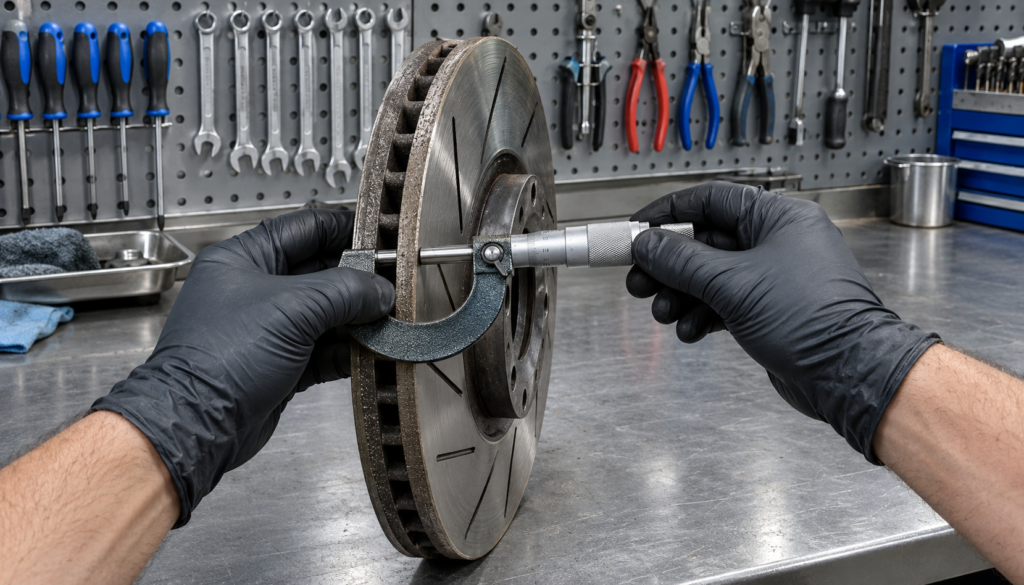
- A quick visual check can mislead. Shiny slots do not mean healthy rotors. Measure thickness with a micrometer.
Bedding In and Lifespan of Slotted Brake Rotors
New rotors and pads need bedding in, a controlled series of moderate stops that transfers an even layer of pad material onto the rotor surface. Skipping it is a leading cause of early vibration. Follow the instructions that come with your pads, and avoid holding the brakes on after a hard stop while everything is still hot.
The lifespan of slotted rotors is usually similar to or slightly shorter than blank rotors, because the extra pad shaving adds wear. Rotor wear is measured against the minimum thickness stamped on the rotor, and replacement is due when the rotor reaches it or shows cracks, deep grooves, or heat spots.
When to See a Mechanic
Ask a mechanic to inspect your brakes if you notice any of these after installing or while driving on slotted rotors: a pulsing pedal or steering wheel shake under braking, grinding that does not go away after the pads bed in, a pedal that sinks or feels soft, a vehicle that pulls to one side when stopping, or visible cracks starting from a slot. Brakes are a safety system, and these are not symptoms to keep driving on.
FAQ
Q. Are slotted brake rotors better than blank rotors?
A. Only for certain driving. Slotted rotors help in towing, performance driving, and wet or dusty conditions. For a normal commute, blank rotors are quieter and last longer.
Q. Do slotted rotors wear out brake pads faster?
A. Slightly. The slots keep shaving the pad face, so pads tend to wear a bit faster than on smooth rotors.
Q. Can I put slotted rotors on any car?
A. If they match your vehicle’s rotor diameter, thickness, and mounting, yes. Always buy by exact fitment for your make and model.
Q. Are slotted rotors safe for daily driving?
A. Yes. Quality slotted rotors are safe on the street. You may hear mild whirring noise and see a small increase in pad wear.
Q. Slotted or cross-drilled rotors: which is better?
A. Slotted rotors are the safer choice for hard use because drilled holes can crack under repeated heat. Cross-drilled rotors are mostly a looks-first option.