
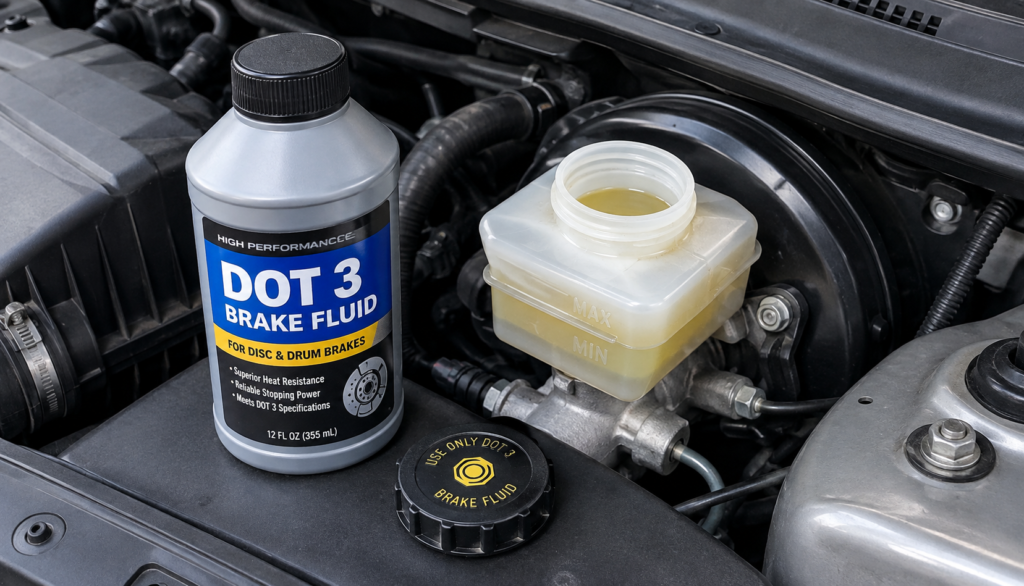
If you’ve popped the hood to check your brake fluid reservoir and seen “DOT 3” printed on the cap, you might be wondering what that actually means — and whether it matters which bottle you grab off the shelf. It does. DOT 3 is one of the most common brake fluid types on the road today, but it’s not interchangeable with every other type, and using the wrong one can affect how your brakes perform over time.
Here’s what DOT 3 brake fluid is, how it compares to DOT 4 and DOT 5, and what you need to know before you top off or flush your system.
What Is DOT 3 Brake Fluid?
DOT 3 brake fluid is a glycol-based hydraulic fluid used in the braking systems of most passenger cars, SUVs, and light trucks. The “DOT” stands for Department of Transportation, which sets minimum performance standards for brake fluid sold in the United States under Federal Motor Vehicle Safety Standard 116 (FMVSS 116). DOT 3 is one of several ratings under that standard, alongside DOT 4, DOT 5, and DOT 5.1.
Brake fluid’s job is simple in concept but critical in practice: it transmits the force from your foot on the brake pedal, through the brake lines, to the calipers or wheel cylinders at each wheel. Because brake fluid is a hydraulic fluid, it doesn’t compress — that’s what lets a light push on the pedal turn into strong, even clamping force at all four wheels.
DOT 3 fluid is made from glycol ether, which makes it hygroscopic — it absorbs moisture from the air over time. That’s not a flaw so much as a tradeoff: the glycol base gives DOT 3 good lubricity and compatibility with rubber seals throughout the brake system, but it also means the fluid’s performance slowly degrades as it picks up water, which is why brake fluid isn’t a “fill it once and forget it” fluid.
DOT 3 vs. DOT 4 vs. DOT 5: What’s the Difference?
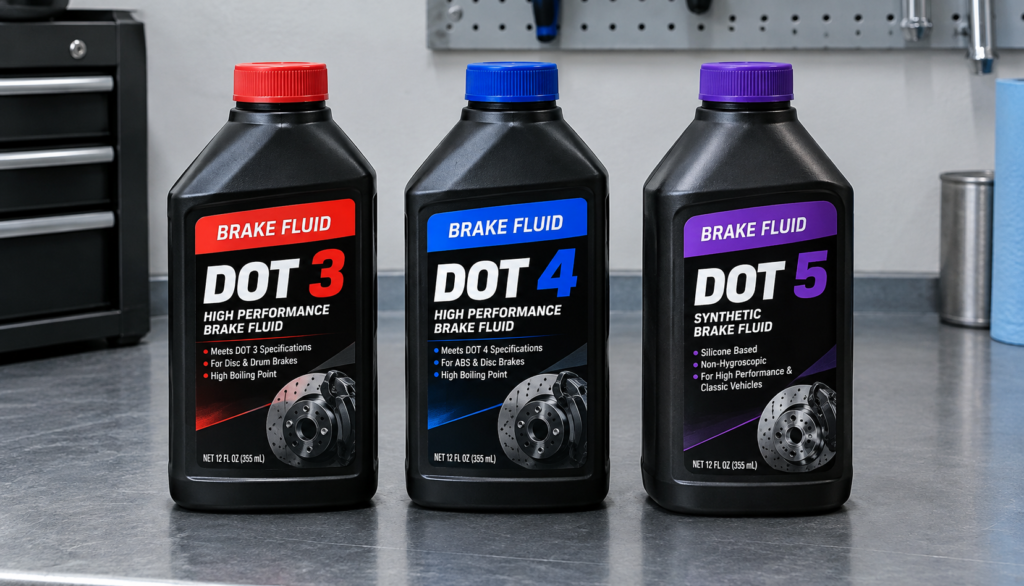
All DOT-rated brake fluids do the same basic job, but they’re rated differently based on two key numbers: dry boiling point and wet boiling point.
- Dry boiling point is the boiling point of fresh, unused fluid straight from a sealed bottle.
- Wet boiling point is the boiling point after the fluid has absorbed a small, standardized amount of moisture — which happens naturally over months and years in a real brake system.
DOT 3 has the lowest minimum boiling point requirements of the common glycol-based fluids, which is why it’s typically specified for everyday passenger vehicles rather than performance cars or heavy-duty towing applications where brakes run hotter. DOT 4 raises both the dry and wet boiling point minimums and absorbs moisture a bit differently, which is why it’s often specified for vehicles with ABS or for drivers who do more aggressive braking, like mountain driving or towing.
DOT 5 is a different animal entirely: it’s silicone-based rather than glycol-based, which means it doesn’t absorb moisture the way DOT 3 and DOT 4 do. That sounds like an upgrade, but silicone fluid compresses slightly under heat and isn’t compatible with ABS systems in most vehicles, which is why it’s mostly reserved for classic cars and specific military and off-road applications rather than daily drivers.
| Type | Base | Absorbs Moisture? | Typical Use |
|---|---|---|---|
| DOT 3 | Glycol ether | Yes | Most passenger cars |
| DOT 4 | Glycol ether (borate ester) | Yes | ABS-equipped vehicles, towing, performance |
| DOT 5 | Silicone | No | Classic cars, specialty/off-road builds |
Can You Mix DOT 3 with DOT 4 or DOT 5 Brake Fluid?
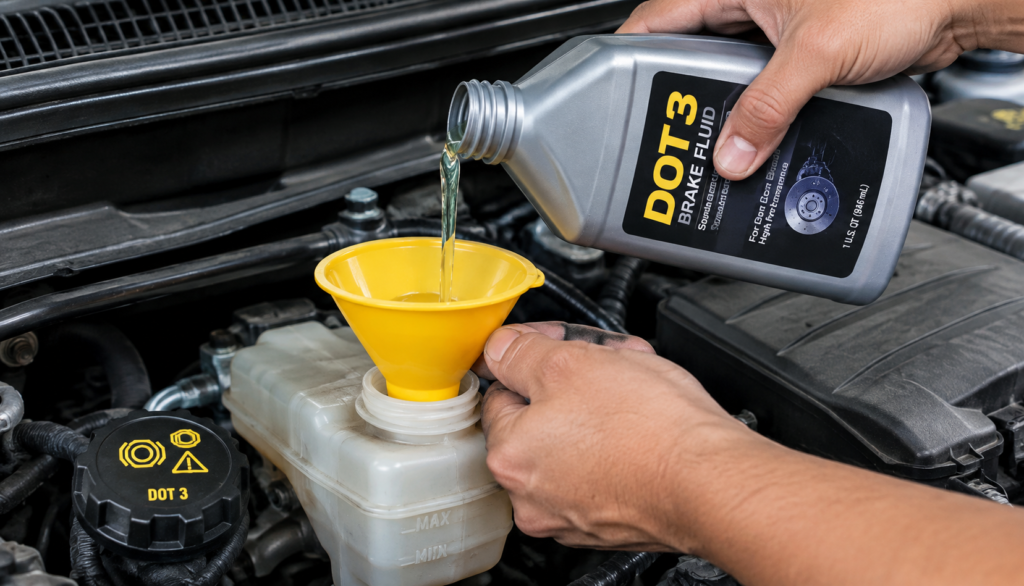
DOT 3 and DOT 4 are both glycol-based, and they’re generally compatible with each other — in a pinch, topping off a DOT 3 system with DOT 4 (or vice versa) won’t damage your brakes. That said, mixing isn’t the same as matching: if your system calls for DOT 4 and you consistently run DOT 3, you lose the higher boiling point margin DOT 4 was specified for, which matters more if you tow, drive mountain roads, or ride the brakes on long descents.
DOT 5 is the one you don’t want to mix in. Because it’s silicone-based instead of glycol-based, DOT 5 doesn’t blend properly with DOT 3 or DOT 4 — the two bases don’t fully mix, which can lead to inconsistent brake feel, seal problems, or trapped air that’s difficult to bleed out. Never top off a DOT 3 or DOT 4 system with DOT 5, and never introduce DOT 3 or DOT 4 into a system that’s been converted to DOT 5.
The safest rule: check your owner’s manual or the label on your brake fluid reservoir cap, and use whichever DOT rating your manufacturer specifies. When in doubt, DOT 3 and DOT 4 can be used somewhat interchangeably in an emergency top-off, but DOT 5 should never be mixed with either.
Which Vehicles Use DOT 3 Brake Fluid?
DOT 3 remains one of the most widely used brake fluids in ordinary passenger cars, especially older models and vehicles that aren’t built for high-performance or heavy-duty braking demands. If your vehicle doesn’t tow heavy loads, isn’t track-driven, and doesn’t have a manufacturer spec calling for DOT 4 or DOT 5.1, there’s a good chance DOT 3 is what’s already in your system.
Newer vehicles, especially those with ABS or electronic stability control, increasingly ship with DOT 4 from the factory because of its higher wet boiling point margin. That’s why it’s worth checking your reservoir cap or owner’s manual rather than assuming — the fluid type isn’t universal across all cars, even within the same manufacturer’s lineup.
How to Tell If Your Brake Fluid Needs Changing
Because DOT 3 is hygroscopic, its protective properties don’t last forever even if the fluid level in the reservoir never drops. A few signs it’s time for a change:
- Fluid color has darkened. Fresh DOT 3 is usually light yellow to clear; fluid that’s turned brown or muddy has likely absorbed moisture and contaminants.
- Spongy or soft brake pedal. This can point to air or moisture in the lines, which lowers the fluid’s effective boiling point.
- It’s been two years or more. Most manufacturers recommend a brake fluid change every two years regardless of mileage, since moisture absorption happens on a timeline, not a mileage counter.
- Brakes feel less responsive after hard or repeated braking. This can be a sign the fluid’s boiling point has dropped enough that heat is starting to affect performance (sometimes called brake fade).
Checking your owner’s manual for the manufacturer’s specific interval is the most reliable approach, since some vehicles call for more frequent changes than others.
What the Warning Light Doesn’t Tell You
A low brake fluid warning light usually gets treated as a simple top-off job — and sometimes it is. But a reservoir that’s noticeably low often means one of two things: your brake pads have worn down enough that the caliper pistons have extended further, which naturally draws down fluid level (normal, and expected as pads wear), or there’s a leak somewhere in the system, which is not normal and needs attention.
The tricky part is that topping off the fluid will usually make the warning light turn off either way — which means a quick DIY top-off can mask a leak rather than fix it. If your fluid level drops again within a few weeks of topping off, or if you notice the pedal feels different (softer, sinking under steady pressure, or needing a pump to firm up), that’s a sign this isn’t just old pads — it’s worth having the system checked for a leak before it becomes a bigger repair.
It’s also worth knowing that simply having “DOT 3 fluid” in the reservoir doesn’t tell you its condition. A system can be topped off with fresh fluid on top of old, moisture-saturated fluid underneath, which is why a full flush (not just a top-off) is what actually resets the clock on your fluid’s protective properties.
FAQ
Q. Is DOT 3 brake fluid the same as DOT 4?
A. No. Both are glycol-based and generally compatible with each other, but DOT 4 has a higher minimum dry and wet boiling point, making it better suited to higher-heat braking conditions like towing or mountain driving.
Q. Can I use DOT 4 instead of DOT 3?
A. In most vehicles, yes — DOT 4 can typically be used where DOT 3 is specified since it meets or exceeds DOT 3’s requirements. Check your owner’s manual to confirm your specific vehicle doesn’t have a reason to avoid it.
Q. What happens if you mix DOT 3 and DOT 5 brake fluid?
A. DOT 5 is silicone-based and doesn’t mix properly with the glycol-based DOT 3, which can cause inconsistent brake feel and trapped air. These two types should never be combined in the same system.
Q. How often should DOT 3 brake fluid be changed?
A. Most manufacturers recommend every two years, since the fluid absorbs moisture from the air over time regardless of how much you drive. Check your owner’s manual for your vehicle’s specific interval.
Q. Why does brake fluid need to be replaced if the level never drops?
A. Brake fluid degrades from moisture absorption even when the reservoir stays full. A low wet boiling point from old, moisture-saturated fluid can lead to a spongy pedal or reduced stopping power under heavy braking, even though the fluid level itself hasn’t changed.