
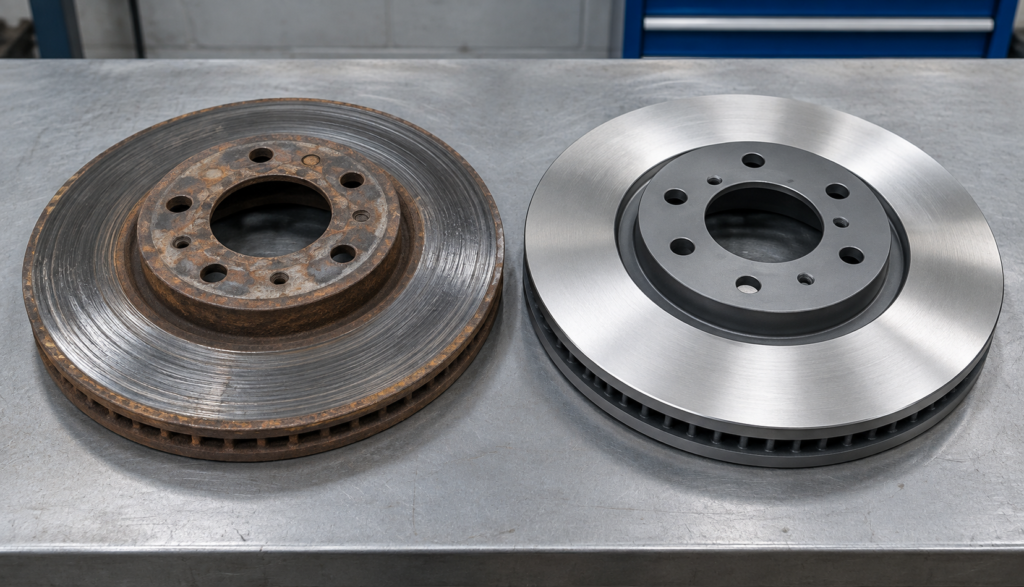
If your car shudders when you brake, makes a grinding or squealing noise, or the pedal feels different than it used to, your brake rotors could be the reason. Brake rotors (also called brake discs) are the flat metal discs that your brake pads clamp down on to slow the car — and like pads, they wear out over time. Unlike pads, though, rotor wear is easy to miss until it starts affecting how the car actually drives.
Here’s how to tell if your rotors are worn out, what causes it, and what it typically costs to fix.
What Brake Rotors Do
Every time you press the brake pedal, the brake caliper squeezes the brake pads against the brake rotor on each wheel. That friction is what actually slows the car down. Rotors take a lot of heat and pressure every time you brake, and over tens of thousands of miles, that surface wears down, warps, or develops grooves. Most cars have separate front rotors and rear rotors, and because the front brakes do more of the stopping work, front rotors typically wear faster.
1. Vibration or Shaking When Braking
A pulsing or shaking feeling through the steering wheel or brake pedal — especially at higher speeds — is one of the clearest signs of warped rotors. When a rotor loses its perfectly flat surface (from heat damage or uneven wear), the brake pads make contact unevenly as the rotor spins. That uneven contact is what you feel as vibration.
Brake rotor pulsation is different from a wheel-balance vibration you feel at speed while not braking — if the shake only happens when you press the brake pedal, it’s much more likely to be the rotors.
2. Grinding or Deep Scraping Noise
A metallic grinding noise when braking usually means your brake pads have worn down completely and metal is now contacting the rotor surface directly. Left alone, this quickly turns into scored or grooved rotors, since bare metal-on-metal contact digs channels into the rotor face. If you catch this early, replacing the pads alone might save the rotors — but once the rotor surface is heavily scored, resurfacing or full replacement is usually needed.
3. Squealing That Doesn’t Go Away After New Pads
Squealing brakes are often just a wear indicator built into the pads doing its job — a normal, harmless noise. But if you’ve already replaced the brake pads and the squeal persists, that points to a rotor problem rather than a pad problem: an uneven or damaged rotor surface can cause noise regardless of pad condition.
4. Visible Grooves, Scoring, or Rust on the Rotor Surface
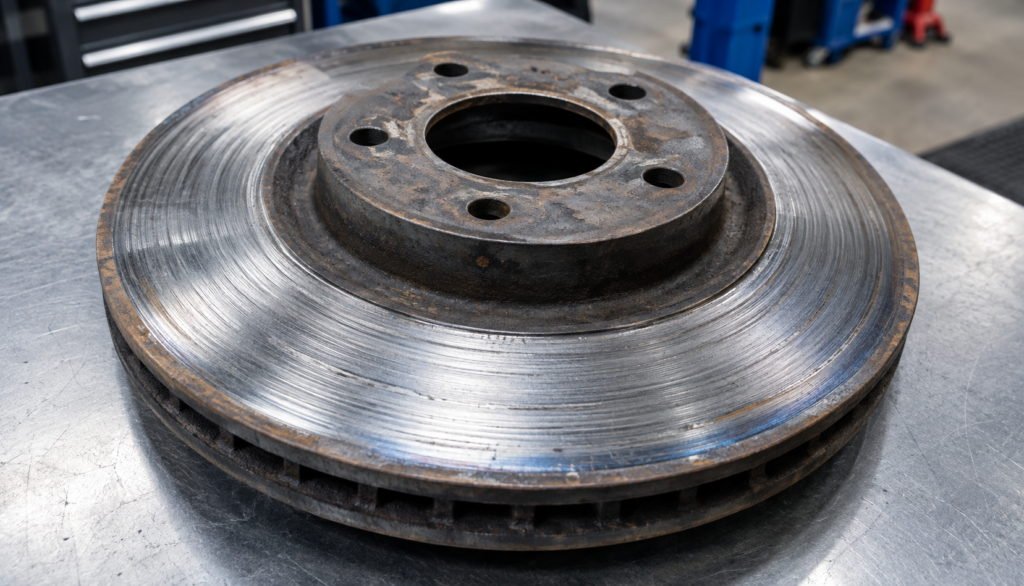
You can often see rotor wear just by looking through the wheel spokes. Deep circular grooves, dark scored lines, or a rotor surface that looks pitted rather than smooth are all signs of wear beyond normal use. A thin layer of surface rust after sitting overnight is normal and clears after a few stops — but rust that doesn’t wipe away with light braking, or rust combined with visible grooves, is a sign the rotor has been sitting worn for a while.
5. Blue or Discolored Rotors
Rotors that look blue, purple, or have rainbow-like discoloration have been overheated — usually from hard braking, towing, mountain driving, or riding the brakes for extended periods. Heat damage from repeated overheating can warp the rotor or change the metal’s hardness, making it wear unevenly going forward even if it looks fine at a glance otherwise.
6. Rotor Thickness Below the Minimum Spec
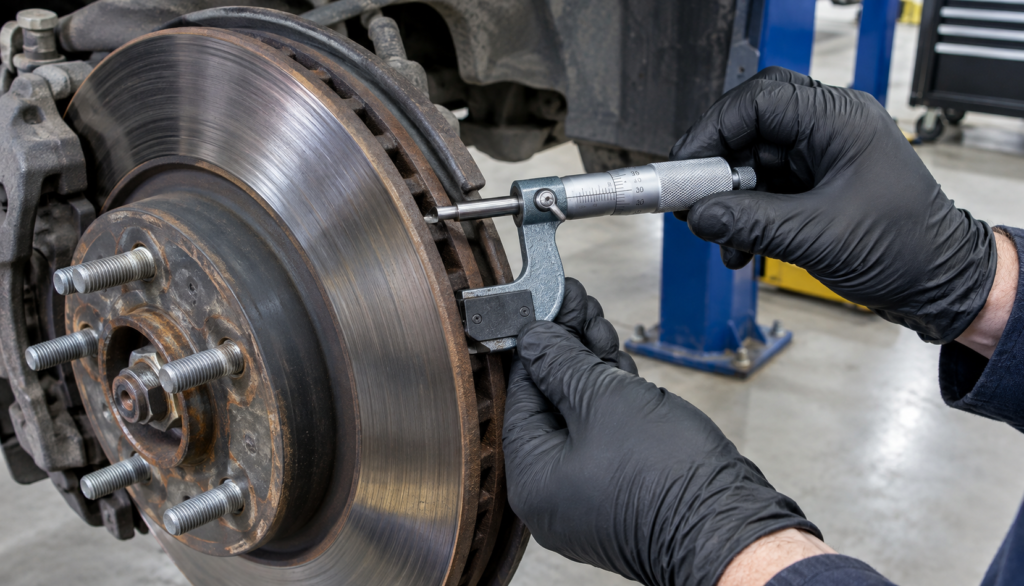
Every rotor has a minimum thickness stamped on it, and a shop can measure yours with a micrometer in a couple of minutes. Once a rotor wears past that minimum, it no longer dissipates heat properly and is at higher risk of cracking under hard braking. Rotor thickness is one of the most reliable ways to know for certain since it’s a real objective measurement, not just an inference from noise or feel.
7. It’s Been a While Since Your Last Brake Inspection
If it’s been more than a year, or you don’t remember your last brake inspection, that alone is a reason to get the rotors checked — especially if you’ve noticed any of the symptoms above. Rotor wear is gradual, so many drivers get used to the vibration or noise without realizing it’s steadily gotten worse.
What the Warning Light Doesn’t Tell You
Most cars don’t have a dedicated rotor warning light — the closest thing is often an ABS light, which can come on for reasons unrelated to rotor wear, like a faulty ABS sensor. That means rotor problems can go unflagged by your dashboard entirely, even as the symptoms above get worse.
It’s also easy to assume new brake pads will fix a noise or vibration problem on their own. In reality, if the rotors are already warped, scored, or under minimum thickness, fresh pads alone won’t solve it — the noise or shake will come right back, sometimes within days, because the new pads are gripping the same damaged surface. A mechanic can tell you quickly whether the rotors need resurfacing (machining the surface flat again, when there’s enough material left) or full rotor replacement — but resurfacing has its limits, since it removes some of the rotor’s remaining thickness each time it’s done.
Rotor Replacement Cost
Brake rotor replacement cost typically runs $200–$400 per axle for parts and labor on most vehicles, including pads (rotors and pads are usually replaced together). Costs vary based on:
| Factor | Effect on Cost |
|---|---|
| Front vs. rear rotors | Front rotors are often slightly more expensive due to larger size on many vehicles |
| Ceramic vs. metallic pads | Ceramic pads typically cost more but wear more evenly and produce less brake dust |
| Drilled/slotted vs. standard rotors | Drilled and slotted rotors cost more and are usually unnecessary for typical daily driving |
| Vehicle type | Larger vehicles and performance cars often use larger, pricier rotors |
Rotor resurfacing, where available and appropriate, costs less than full replacement — but many shops recommend replacement outright once a rotor is already showing wear, since resurfacing only works within a narrow thickness margin.
Can You Still Drive With Worn Rotors?
Mild vibration or occasional light rust is generally safe to drive on short-term while you schedule an inspection. But grinding noise, a rotor below minimum thickness, or a pedal that feels noticeably softer or longer than normal are signs your stopping distance is being affected — at that point, it’s not safe to keep driving on it, and you should get it inspected before your next trip.
Frequently Asked Questions
Q: How long do brake rotors last?
A: Most brake rotors last between 30,000–70,000 miles, though this varies widely based on driving style, climate, and pad quality. Stop-and-go city driving and frequent hard braking wear rotors faster than steady highway driving.
Q: Do I need to replace rotors every time I replace brake pads?
A: Not always. If the rotors are still within spec and don’t show grooving, vibration, or discoloration, they can often be reused with new pads. A mechanic can measure rotor thickness to confirm.
Q: Can I resurface rotors instead of replacing them?
A: Yes, if there’s enough material left above the minimum thickness after machining. Resurfacing restores a flat surface but removes some thickness each time, so a rotor can typically only be resurfaced once or twice before replacement is necessary.
Q: Why do my rotors keep rusting?
A: Light surface rust after the car sits overnight is completely normal and burns off with normal braking. Persistent rust that doesn’t clear usually means the car isn’t being driven often enough, or the pads aren’t making full contact with the rotor surface.
Q: Is a grinding noise always the rotors?
A: Not necessarily — grinding is most often caused by brake pads worn down to metal, which then damages the rotor. Getting it checked promptly can sometimes save the rotors if caught before the pads wear through completely.