
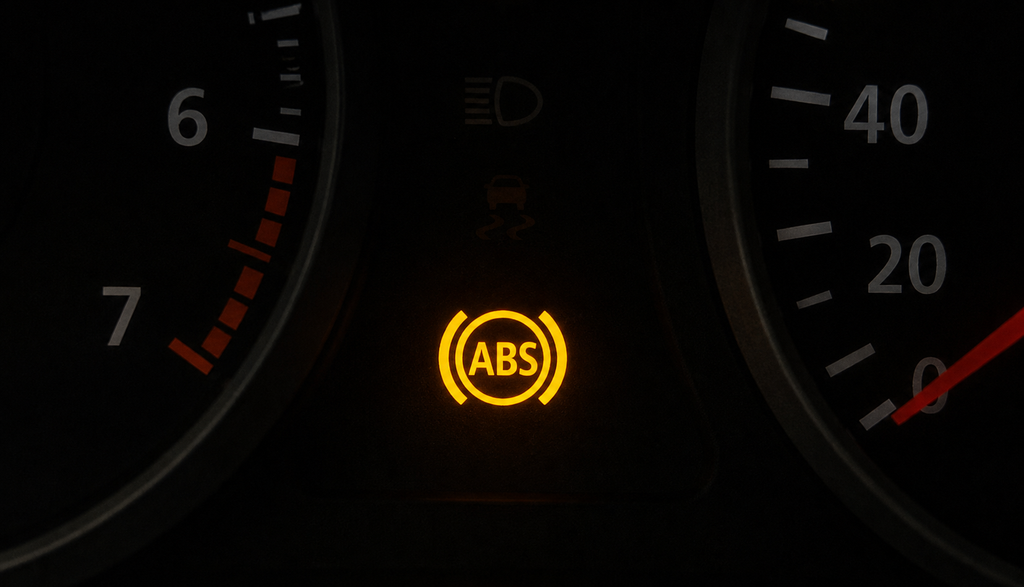
If your ABS light just came on, the first question is usually the same one everyone asks: is this serious, or can it wait? The short answer is that your regular brakes still work — but the safety system designed to keep you in control during hard or panic stops may not be. This guide walks through what triggers the light, what it means for your driving, and when it’s worth getting checked out.
What Is the ABS Light?
The ABS light is a dashboard warning light tied to your vehicle’s anti-lock braking system. If you’re wondering what the ABS light is in plain terms, it’s tied to a system that prevents your wheels from locking up and skidding when you brake hard, especially on wet, icy, or loose surfaces. Instead of your tires grinding to a stop and losing traction, the system rapidly pulses the brakes at each wheel, letting you keep steering control while still slowing down quickly.
When the ABS light turns on, it means the onboard computer has detected a fault somewhere in that system. It’s separate from your regular brake warning light, though the two can sometimes come on together depending on what’s wrong.
Why Is My ABS Light On? Common Causes
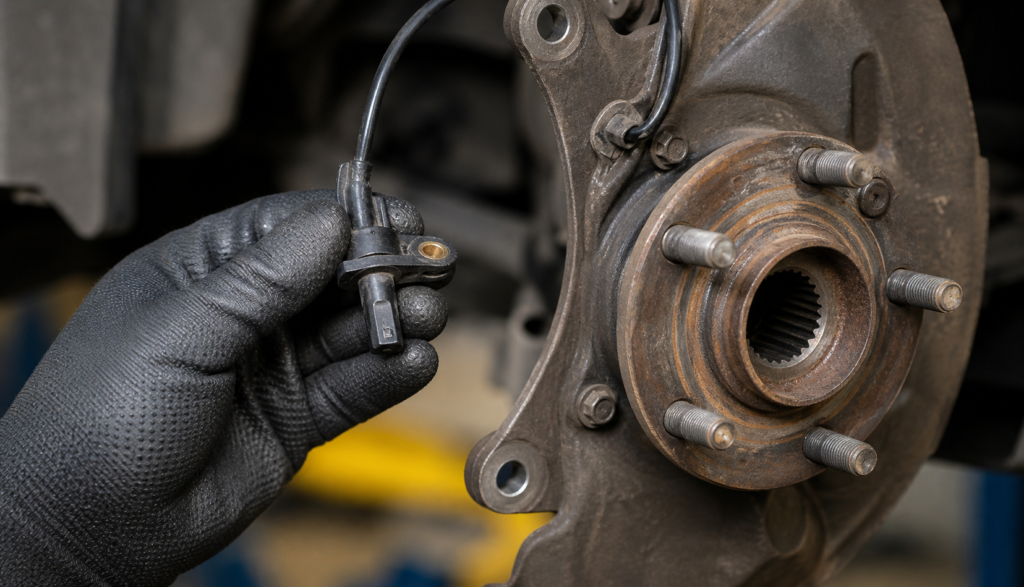
Why is my ABS light on? It’s one of the most common questions people search for this exact warning light, and for good reason — there isn’t just one cause. Here are the most common culprits, ranked roughly from most to least frequent:
- Faulty wheel speed sensor — Each wheel has a sensor that tells the ABS module how fast that wheel is spinning. A dirty, damaged, or failing sensor is the single most common reason the light comes on.
- Damaged or corroded wiring — The wiring that runs from each wheel speed sensor back to the ABS module can fray, corrode, or get damaged by road debris, especially near the wheel wells.
- Low brake fluid level — Since ABS relies on hydraulic brake pressure, a low fluid level can trigger the light. This is often paired with the regular brake warning light too.
- Bad wheel bearing — A worn wheel bearing can throw off the speed sensor’s readings even if the sensor itself is fine.
- Failing ABS module or pump — The control module or hydraulic pump assembly itself can fail, particularly on older vehicles.
- Blown ABS fuse — Sometimes the fix is as simple (and as cheap) as a blown fuse cutting power to the system.
- Low tire pressure or mismatched tire sizes — Because ABS compares wheel speeds to detect a problem, tires that are significantly under-inflated or mismatched can occasionally trip a false reading.
On many vehicles, disconnecting or reconnecting the battery can also cause the ABS light to come on after a battery change, even temporarily. In that case, it sometimes resets itself after a short drive as the module recalibrates — though if it stays on, it’s worth a scan.
Is It Safe to Drive With the ABS Light On?
This is the part most drivers actually want to know: is it safe to drive with the ABS light on? In most cases, yes — you can still drive, and your regular braking will work normally under everyday, gentle stops. What you lose is the anti-lock protection during hard braking or on slippery surfaces. That means:
- Longer stopping distances on wet or icy roads
- A higher risk of wheel lockup and skidding during a panic stop
- Reduced steering control while braking hard, since a locked wheel can’t help you steer
It’s not an emergency that requires pulling over immediately, but it’s also not something to ignore for months. Treat it the way you’d treat a smoke detector with a low battery — everything still functions day to day, but the safety net you’re counting on in a real emergency may not be there.
ABS Light and Traction Control Light Together
Seeing the ABS light and traction control light together is actually a common — and informative — pairing. Traction control uses the same wheel speed sensors as ABS to detect slipping. When both lights come on at once, it usually points straight to a wheel speed sensor problem rather than something specific to only one system. This combination is one of the more diagnostically useful patterns mechanics look for.
ABS Light Comes On and Off, or Won’t Turn Off
Two patterns are worth calling out separately, since they hint at different problems:
- Comes on and off intermittently — This pattern often points to a wiring connection that’s loose or corroded, or a sensor that’s failing but not dead yet. It can also show up with a wheel bearing that’s just starting to wear.
- Stays on constantly and won’t turn off — This more often points to a fully failed sensor, a stuck fault code, or a module issue that needs a diagnostic scan to properly diagnose and clear.
How to Diagnose an ABS Light
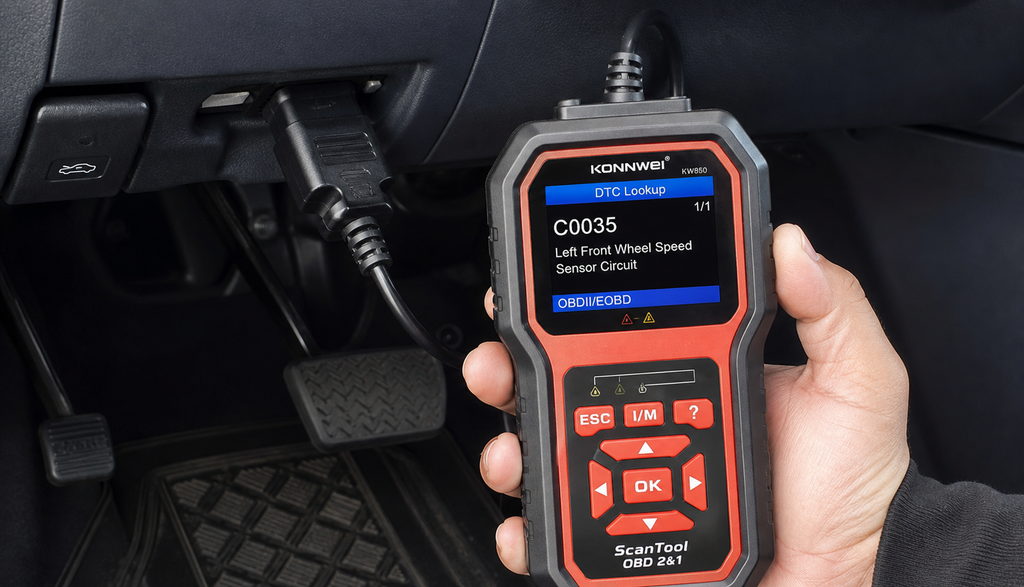
You don’t need a shop visit just to find out what’s wrong — a basic diagnostic scan is the fastest way to narrow things down:
- Check the brake fluid reservoir. Confirm the fluid is at the proper level before anything else.
- Check tire pressure across all four tires. Rule out a pressure mismatch as the trigger.
- Pull the code with an OBD2 scanner. Many auto parts stores will do this for free, and it will point to a specific wheel speed sensor, circuit, or module fault.
- Inspect the sensor and wiring at the flagged wheel. Visible corrosion, a cracked sensor, or damaged wiring insulation is often visible without removing anything.
- Have a mechanic confirm with a full diagnostic scan if the code doesn’t clearly point to one part, or if it returns after clearing it.
ABS Light Repair Cost
Cost varies a lot depending on what’s actually failed:
- Blown fuse: Under $20, often a DIY fix
- Wheel speed sensor replacement: Roughly $150–$400 per sensor, including labor
- Wiring repair: $100–$300 depending on accessibility and damage
- Wheel bearing replacement: $250–$500 per wheel
- ABS module or pump replacement: $500–$1,500+, the most expensive common repair on this list
A diagnostic scan at a shop typically runs $50–$150 if you don’t have access to a scanner yourself, though many parts stores will read the code for free.
What the Warning Light Doesn’t Tell You
The ABS light itself doesn’t tell you how urgent the underlying problem actually is — and that’s where a lot of drivers make the wrong call in either direction. A few things worth knowing:
- A quick fix isn’t always a full fix. Clearing the code with a scanner can make the light go off temporarily even if the underlying sensor or wiring issue hasn’t actually been repaired. If it comes right back, that’s confirmation, not a fluke.
- The light doesn’t distinguish between minor and serious causes. A blown fuse and a failing ABS module trigger the exact same warning light. You genuinely can’t tell which one you’re dealing with without pulling the code — guessing based on symptoms alone isn’t reliable here.
- If the regular brake light comes on with it, treat it differently. ABS light alone means you’ve lost the anti-lock safety net. ABS light plus the brake warning light together can mean an actual loss of hydraulic brake pressure, which is a same-day, not same-month, situation.
- Ignoring it doesn’t just risk the ABS system. A bad wheel speed sensor left unaddressed can also affect traction control and stability control, since all three systems typically share the same sensors and data.
When to See a Mechanic
Get it looked at promptly, rather than urgently, in most cases — but move up the timeline if any of the following apply:
- The brake warning light is on at the same time as the ABS light
- Your brake pedal feels soft, spongy, or sinks toward the floor
- You notice longer stopping distances or unusual pulsing when braking normally (not during a hard stop)
- The light stays on after a battery disconnect and doesn’t clear after a short drive
- You drive frequently in wet, icy, or mountainous conditions where ABS matters most
If none of those apply, it’s still worth scheduling a diagnostic scan within the next week or two rather than letting it linger indefinitely.
Frequently Asked Questions
Q. Can I still drive with the ABS light on?
A. Yes, in most cases. Your regular brakes will still function for normal, everyday stops. What you lose is anti-lock protection during hard braking or on slippery roads, so it’s worth getting checked soon rather than ignoring it long-term.
Q. Why did my ABS light come on after I changed my battery?
A. Disconnecting the battery can temporarily reset the ABS module’s calibration, which sometimes triggers the light. It often clears itself after a short drive as the system recalibrates. If it doesn’t clear, a diagnostic scan can confirm whether it’s coincidental or an actual fault.
Q. What does it mean if the ABS light and traction control light are on together?
A. This combination usually points to a wheel speed sensor problem, since both systems rely on the same sensors to function. It’s one of the more useful diagnostic patterns because it narrows down the likely cause.
Q. How much does it cost to fix an ABS light?
A. It depends on the cause. A blown fuse might cost under $20, a wheel speed sensor typically runs $150–$400, and a full ABS module replacement can run $500–$1,500 or more. A diagnostic scan is the only way to know which repair you actually need.
Q. Is the ABS light the same as the brake warning light?
A. No. The ABS light specifically relates to the anti-lock braking system, while the brake warning light typically relates to brake fluid level or overall brake system pressure. They can illuminate independently or together, and seeing both at once usually signals a more urgent issue.