
When the ABS light and traction control light glow on your dashboard at the same time, the car is telling you that two safety systems have switched themselves off. Your regular brakes will almost always still work, but the safety net that stops the wheels from locking up or spinning has gone quiet. This guide explains why the abs and traction control lights are on together, which parts usually fail, what a repair cost looks like, and when it is safe to drive.
Most of the time the culprit is small and cheap, such as a dirty wheel speed sensor or a weak battery. Occasionally it points to something bigger, like a failing abs module. Knowing the difference saves you from paying for the wrong repair.
Why Are the ABS and Traction Control Lights On at the Same Time?
The anti-lock braking system and the traction control system share the same hardware. Both rely on the wheel speed sensor at each corner of the car, and both are managed by the same abs module and hydraulic control unit. When one of those shared parts reports a fault, the computer shuts down both systems and turns on both lights.
That is why a single failed sensor can light up two warning lights at once. The computer cannot trust the speed readings, so it stops using them. On many cars the stability control light, sometimes called electronic stability control or ESC, comes on too, because it uses the same sensors plus the steering angle sensor.
What Each Light Actually Means
The ABS light means the anti-lock function is disabled. Under hard braking the wheels can lock, so you lose some steering control on wet or loose surfaces. The traction control light, often a car with squiggly lines, normally flashes when the system is working. If it stays on steadily, it means the system has a fault and is turned off.
Some drivers wonder whether the traction control light means the car is slipping. Only when it flashes. A steady light means a fault, and a flashing light means the system is actively reducing power because a tire is losing grip.
| Light behavior | What it usually means |
|---|---|
| Traction control flashing while driving | The system is working on slippery roads |
| Traction control steady on | Fault detected or system turned off |
| ABS steady on | Anti-lock function disabled |
| ABS and traction control both steady | Shared sensor, module, or power fault |
| ABS, traction, and brake light all on | Possible hydraulic or brake fluid level problem; stop and check |
Is It Safe to Drive With the ABS and Traction Control Lights On?
In most cases you can drive carefully for a short time. Normal braking still works because the ABS is an add-on to the standard hydraulic brakes. You can drive with the abs and traction control lights on to get home or to a shop, but you should leave extra space, brake earlier, and avoid wet roads and sharp turns at speed.
It is not safe to keep driving if the red brake warning light is also on, if the brake pedal feels soft or sinks to the floor, or if the car pulls to one side. Those signs point to a hydraulic problem, not just a sensor fault. If you have an abs light on and brakes feel soft at the same time, stop driving and get the car towed.
Common Causes of the ABS and Traction Control Lights Staying On
These are the most frequent causes, listed from the most common and cheapest to the least common and most expensive.
| Cause | How common | Typical repair cost |
|---|---|---|
| Faulty or dirty wheel speed sensor | Very common | $150 to $350 |
| Damaged sensor wiring harness or connector | Common | $100 to $300 |
| Weak battery or low battery voltage | Common | $120 to $300 |
| Blown fuse | Occasional | $5 to $50 |
| Cracked tone ring or bad wheel bearing | Occasional | $200 to $600 |
| Steering angle sensor fault | Occasional | $150 to $500 |
| Failed abs module or hydraulic control unit | Less common | $500 to $2,500 |
Wheel Speed Sensor Problems
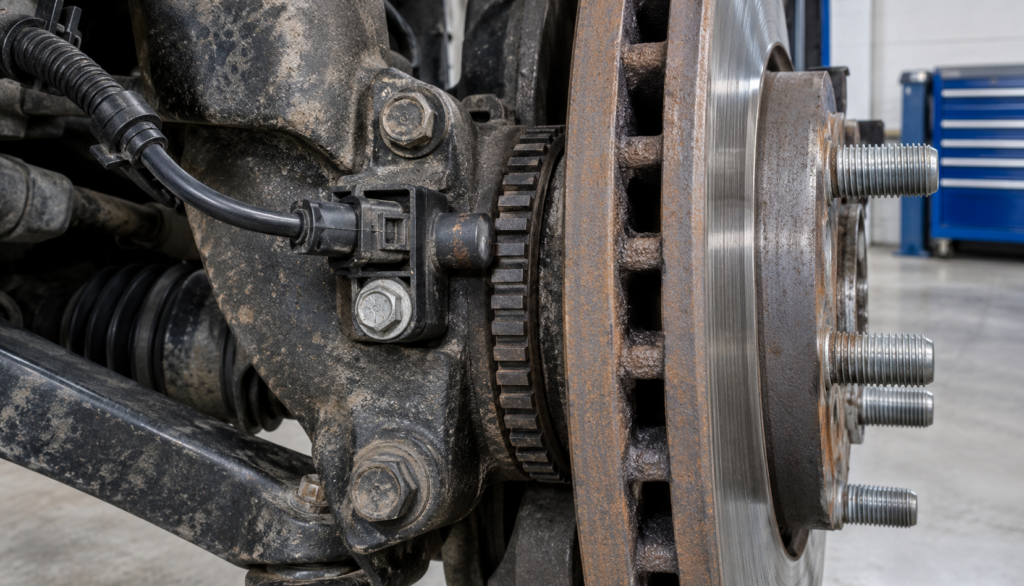
Each wheel has an abs sensor that reads the spinning tone ring. Road grime, metal debris, and rust can foul the sensor, and age can break it internally. A single bad sensor is the number one reason both lights come on together.
Low Battery or Charging Problems
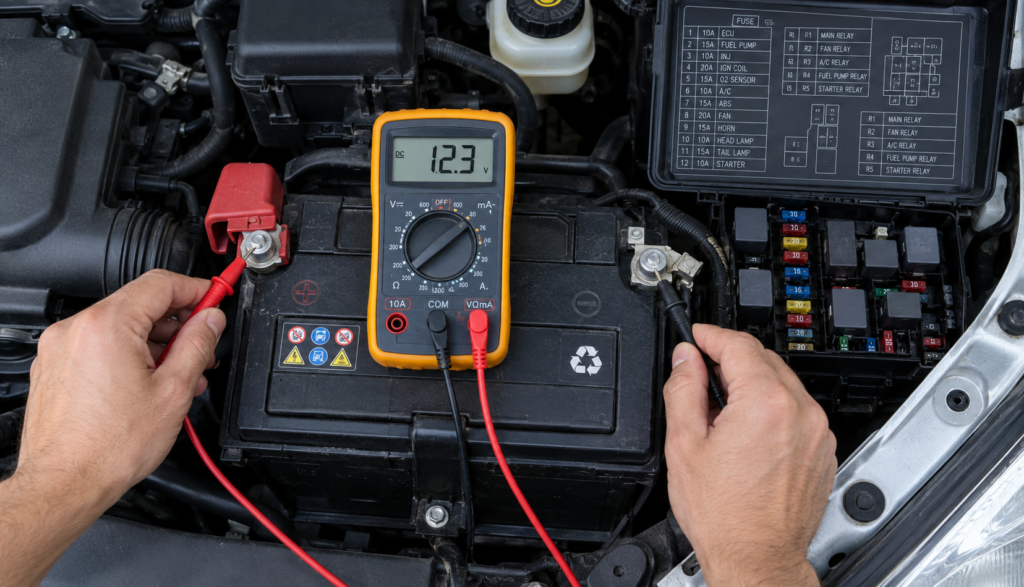
The abs module is sensitive to voltage. Can a bad battery cause abs and traction control lights? Yes. When battery voltage drops during cranking or while the alternator is failing, the module can log a fault and switch the systems off. If the lights appeared right after a hard start, check the battery first.
Blown Fuse or Wiring Damage
Yes, a blown fuse can cause the abs light to come on. Check the fuse box for the abs pump and module fuses. Wiring near the wheels also takes a beating from rocks, salt, and tire changes.
Low Brake Fluid
Low brake fluid level in the reservoir can trigger the abs light, because a sensor in the reservoir tells the computer when the level drops. Low fluid usually means worn brake pads or a leak, so do not just top it off and forget about it.
Tire and Wheel Issues
Mismatched tire size, very uneven tire pressure, or a failing wheel bearing can change how fast one wheel spins compared with the others. Can mismatched tires cause the traction control light? They can, because the computer thinks a wheel is slipping.
How to Diagnose the Problem Yourself
You do not need a shop to get a first answer. Start with the simple checks and work toward the harder ones.
- Turn the ignition off, wait a minute, and restart the car. If the lights go out, a temporary glitch or low voltage may have caused them.
- Check the brake fluid level in the reservoir and look for the traction control button, which may have been switched off by accident.
- Test the battery. Anything below about 12.4 volts at rest deserves attention.
- Check the abs and traction control fuses in the fuse box.
- Check tire pressure on all four tires and make sure the tire size matches front to rear.
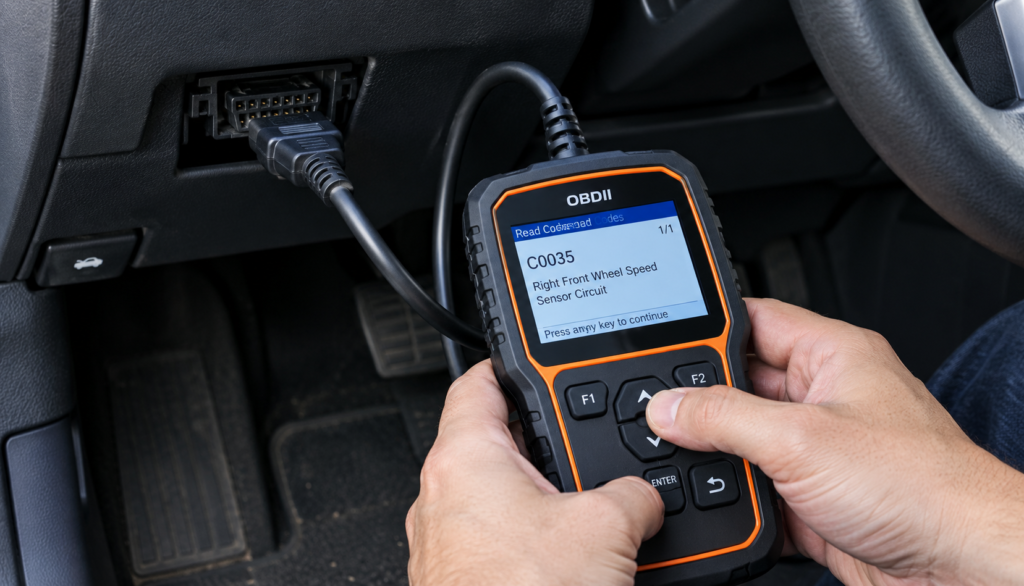
- Plug in an OBD2 scanner that supports abs codes and read the diagnostic trouble code.
A basic code reader only shows engine codes. To learn how to read abs codes you need a scanner that supports the ABS system. Brake and ABS codes usually begin with a C, such as C0035 for a wheel speed sensor circuit, and the last digits point to the wheel involved. The check engine light normally stays off for these faults, so do not assume everything is fine just because it is dark.
How Much Does It Cost to Fix?
The repair cost depends entirely on the cause. A diagnostic scan at a shop usually runs $90 to $150, and many shops credit it toward the repair. Replacing one wheel speed sensor is the typical fix, and parts are often $30 to $120 with labor making up the rest. How much does it cost to fix an abs sensor on a normal car? Expect roughly $150 to $350 per sensor.
If the abs module is the problem, the bill climbs fast. A rebuilt module can cost $300 to $800 installed, while a new module or hydraulic control unit on some vehicles reaches $1,500 to $2,500. Always confirm the fault with codes before agreeing to a module replacement.
What the Warning Light Doesn’t Tell You
The lights tell you something is wrong, but not what, and that gap causes expensive mistakes.
First, clearing the code does not fix anything. You can reset the light with a scanner or by disconnecting the battery, and it may go off for a day, but if the fault is real it will return. Resetting a light on a failing sensor only hides the problem until the next hard stop.
Second, the wheel the code points to is not always the broken part. A code for the front left sensor can come from a damaged wiring harness, a cracked tone ring, or a worn wheel bearing that lets the hub wobble. Replacing the sensor without checking those parts is a common reason the light returns a week later.
Third, the car may enter a reduced mode. Some vehicles also cut engine power or turn off stability features, which feels like limp mode in certain situations. If the car feels strange as well, that points past a simple sensor.
Fourth, the quick DIY test can mislead you. The lights that vanish after a restart are not cured, they are only dormant. A weak battery can make the problem seem to fix itself, while the real trouble comes back during the next cold start.
Why the Lights Come On and Off
Why does the traction control light come on and off? Intermittent lights usually mean an intermittent connection. A loose connector, a sensor that fails only when hot or wet, or a battery that sags under load can all trigger the lights briefly. Moisture is a classic cause: if you see the abs and traction control lights on after rain, a corroded sensor connector is a likely culprit.
If the abs light is flashing rather than steady, that can point to a different fault pattern on some makes, so a scan is the quickest way to tell. Another frequent trigger is a recent job, such as an abs light on after a tire rotation or an abs light on after a brake job. Either one often means a sensor was knocked, a connector was left unplugged, or a tone ring was damaged during the work.
When to See a Mechanic
Take the car to a mechanic if the lights stay on after a restart, if you have already checked the battery and fuse, or if you cannot read the abs codes yourself. Go sooner if the brake pedal feels soft, the red brake light is on, or the car pulls under braking.
You can fix the wheel speed sensor yourself on many cars if you have basic tools, a jack, and jack stands. The job often takes under an hour. Hydraulic unit and module work is best left to a shop with the right scan tools, because the system needs to be bled and programmed afterward.
Also remember inspection rules. In many areas an active abs warning light can fail a safety inspection, so ask whether it will pass inspection before you wait too long.
Frequently Asked Questions
Q. Can I drive with the ABS and traction control lights on?
A. Yes, for a short distance if the brake pedal feels normal and the red brake light is off. Drive slowly, leave extra stopping distance, and get the system scanned soon.
Q. Can a bad battery cause the ABS and traction control lights to come on?
A. Yes. Low voltage can make the abs module log a fault and disable both systems. Test the battery and charging system before replacing any sensors.
Q. How do I reset the ABS and traction control lights?
A. Fix the underlying fault first, then clear the code with an ABS-capable scanner. If the cause is still present, the lights will come back on within a few miles.
Q. Does the ABS light affect normal braking?
A. No. Your standard brakes still work. You only lose the anti-lock function, which matters most in emergency stops and on slippery roads.
Q. How much does it cost to fix both lights?
A. Most repairs fall between $150 and $350 for a wheel speed sensor. A failed abs module or hydraulic unit can cost $500 to $2,500.